World: Earliest Extant Instruments
Hundreds of examples of broken pipes made from animal, bird or human bones, and pipes made from clay,
have been found world-wide.
Some of these
may have developed into the three-hole pipe as we know it today.
There is no
evidence as yet
that they were played
with any percussion instrument. These are random examples
of excavated early pipes.
Drums also have a long history.
|
||||
 43,000 BCE Upper Paleolithic mammoth ivory, Hohle Fels, southern Germany 43,000 BCE Upper Paleolithic mammoth ivory, Hohle Fels, southern Germany |
||||
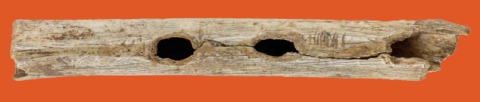 25,000 BP Gravettian period, vulture bone (radius) 25,000 BP Gravettian period, vulture bone (radius) Isturitz cave, Basque country, Pyrénées-Atlantiques, France |
||||
| 12,000 BP Eynan-Mallaha, Northern Israel.
7 pipes from bird wing bones, humerus, ulna and radius from the Eurasian teal and the Eurasian coot All the instruments have been used |
||||
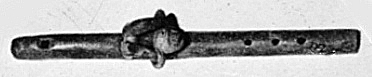 prehistoric Mexico prehistoric Mexico |
||||
 prehistoric Mexico prehistoric Mexico |
||||
 Stone/Bronze age transitional period, Vallby, Scania, Sweden Stone/Bronze age transitional period, Vallby, Scania, Sweden |
||||
 3rd-4th century BCE China 3rd-4th century BCE China |
||||
 300 BCE-300CE clay, western Mexico 300 BCE-300CE clay, western Mexico |
||||
 2nd century A.D, Roman times,
Flavia Solva, Austria 2nd century A.D, Roman times,
Flavia Solva, Austria |
||||
 replica c.950AD replica c.950AD |
 c.950 AD
Haithabu swan bone flute, North Germany c.950 AD
Haithabu swan bone flute, North Germany |
|||
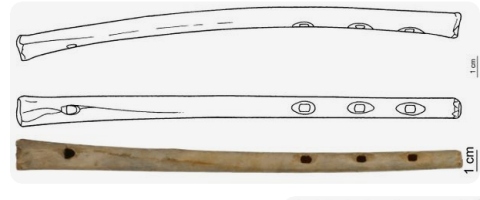 7th-9th centuries made of the right ulna of a whooper or a mute swan 7th-9th centuries made of the right ulna of a whooper or a mute swan Wijnaldum-Tjitsma, Netherlands |
||||
|
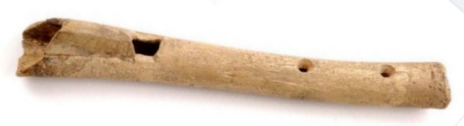 Anglo-Saxon 7th-8th century lamb tibia bone, Malham pipe, Yorkshire, England. Anglo-Saxon 7th-8th century lamb tibia bone, Malham pipe, Yorkshire, England.Tune played on this pipe here |
|||
 reconstruction Clifford Street, York, England [fig 9b] reconstruction Clifford Street, York, England [fig 9b]Recreation played Made and Photo by Lucy-Anne Taylor |
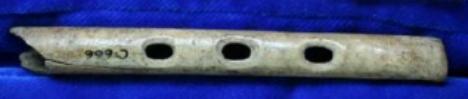 Anglo Scandinavian swan ulna pipe, Clifford Street, York, England Anglo Scandinavian swan ulna pipe, Clifford Street, York, England |
|||
 reconstruction 11th century Poland reconstruction 11th century Poland |
 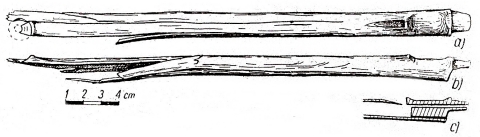 11th century Poland 11th century Poland |
|||
 1008 onwards wood pipe, Colletiere, Paladru Lake, France 1008 onwards wood pipe, Colletiere, Paladru Lake, France |
||||
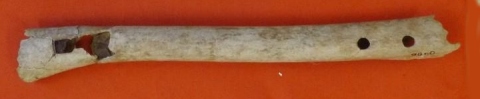 12th/13th century bone Abingdon, England 12th/13th century bone Abingdon, England |
||||
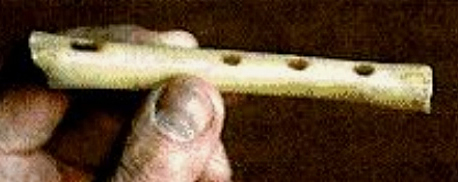 replica of early 13th century pipe Denmark replica of early 13th century pipe Denmark |
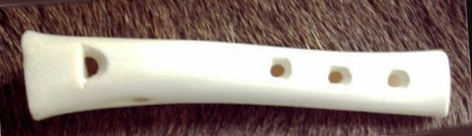
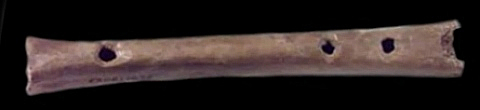 early 13th century sheep shin bone (tibia) one hole underneath; Åarhus, Denmark early 13th century sheep shin bone (tibia) one hole underneath; Åarhus, Denmark |
|||
 medieval pipe made from goose ulna, Southgate Street, Gloucester, England [number 25] medieval pipe made from goose ulna, Southgate Street, Gloucester, England [number 25] |
||||
 after c1200 crane lower leg, Lady Wooton’s Green, Canterbury, England after c1200 crane lower leg, Lady Wooton’s Green, Canterbury, England |
||||
 1200-1232 sheep or goat bone,
Trichay Street, Exeter, England 1200-1232 sheep or goat bone,
Trichay Street, Exeter, England |
||||
|
||||
 13th century (?) sheep tibia, excavated from a moat round a monastery in Deventer 13th century (?) sheep tibia, excavated from a moat round a monastery in Deventerthe Netherlands. The (shrunken) wooden block is still in place. Photo by the authors/Provincial Depot A. Verlinde, Deventer. |
||||
 medieval sheep shin bone, Turku, Finland medieval sheep shin bone, Turku, Finland (town was founded at the turn of the 13th and 14th centuries) |
||||
 medieval pig tibia, Cambridgeshire, England medieval pig tibia, Cambridgeshire, England |
||||
 13th-16th century
sheep or goat tibia bone,
The castle of Teutonic Order in Viljandi, Estonia 13th-16th century
sheep or goat tibia bone,
The castle of Teutonic Order in Viljandi, Estonia LIETUVOS ARCHEOLOGIJA. 2012. T. 38, p. 295–338. page 317, fig 19 |
||||
 15th century wood pipe, Novgorod, Russia 15th century wood pipe, Novgorod, Russia |
||||
 Russia wood Russia wood |
||||
|
|
||||
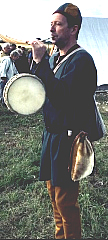 2019 Viking 2019 Viking |
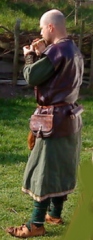 Viking player Viking player |
A good history of flutes/pipes is here and succeeding pages. | ||
 19th century bone, Costa Rica 19th century bone, Costa Rica |
||||
 bone 3-hole pipe from the Amazon, date not known; ornamented with beetle wings bone 3-hole pipe from the Amazon, date not known; ornamented with beetle wings |
||||
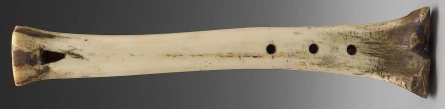 1900-1950 bone, Tukano people, northwestern portion of Brazil, southeastern portion of Colombia 1900-1950 bone, Tukano people, northwestern portion of Brazil, southeastern portion of Colombia |
||||
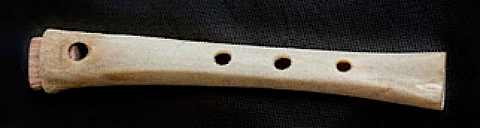 2013 bone pingullo,
Ecuador made by Luis Alberto Gonzáles, used with a drum 2013 bone pingullo,
Ecuador made by Luis Alberto Gonzáles, used with a drum |
||||
Jemez Pueblo makes eagle bone whistles and pipes |
||||
1568 Human bone flutes in America: ‘The new found worlde, or Antarctike : wherein is contained wo[n]derful and strange things, as well of humaine creatures, |
||||
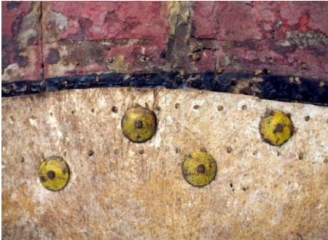
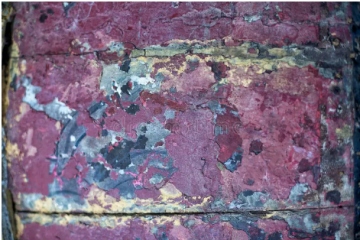
earliest drum |
||||
 |
 |
|||
30,000 BCE elephant skin drum preserved from scavenging as it was buried in ice in Antarctica’s ice age. There is no evidence that it was used with a pipe. Other drums from natural objects such as alligator skin appeared during 5500 BC
in Neolithic cultures |
||||
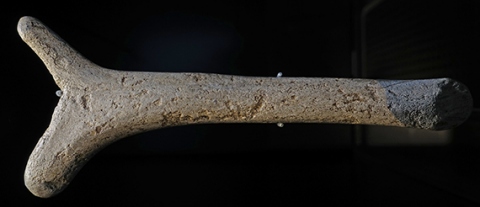 12,000 BP drumstick
made from Reindeer antler 12,000 BP drumstick
made from Reindeer antler
found at Brillenhöhle, Blaubeuren-Seissen, Alb-Donau-Kreis, south-western Germany |
||||
1300-1520 AD In central and west Mexico drumsticks were fashioned from the bones of recently 'The missing femur at the Mitla Fortress and its implications' Antiquity / Volume 84 / Issue 326 / December 2010 |
||||



 “And they will gather together painted with various colours decorated with feathers
top of page