UK terminology
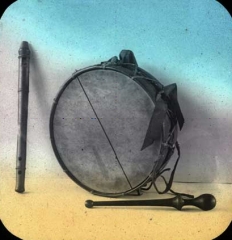 Lantern slide (glass photographic plate; hand-tinted)
Photographer: Henry W Taunt, Oxfordshire, 1860 to 1922.
Copyright: English Heritage. National Monuments Record, 'Merrie England' series. TS00002
The name of the instrument and the person playing them was not fixed in the 19th century. The player (also known as tabor and pipe player), was called a tabor, a taborer, taber, taberer, or a piper. I also have references to a fife and tabor player>, performer on drum and pipe, (also here ^^), a drum and fife player" " , a fife and drum**, fidler and pipe and taborist*. I've come across three fingers and drum^ and many references amongst records of conversations with Victorian morris dancers of the drummer and the tabor and pipe~. Further analysis of Victorian morris dance terminology is here.
1836 : harvest time poem New Lyrical Almanack for 1837
Generally when the word 'piper' is used I assume the piper plays a bagpipe of some sort or another wind instrument
unless I have evidence to the contrary.1591 play: In Peele's 'Edward I', when Lluellen orders the Peddler, the Priest, and the Piper to pay money
to Friar Hugh ap David, the Peddler complains that he has only three pence tucked away in a corner
of his shoe, prompting Rice ap Meredith to wonder aloud if the Piper might have some mutton hidden
in his tabor. The piper is a non-speaking character in the play.1612 an example of a court report on an unknown 'piper':
William Moores, an innkeeper, was accused of not observing the curfew. A piper called John Peacock
had taken up residence in William’s inn in Chester. William:
"sayth That this night last past the said Piper played untill Eleven of the Clocke in the night or theraboutes".
Elizabeth Craddock from Baguley, who was staying at the same inn while en route to see her mother in the Wirral,
"danced after him for a while with an ould man. whose name she knoweth not".
It seems likely that John Peacock was allowed lodging in order to provide entertainment for William’s residents
and guests. He was evidently one of a family of musicians itinerant within the county of Chester.‘MUSIC AND MUSICIANS IN CHESTER: A Summary Account’ by David Mills
1618 play:
“…Where the Piper does find
A more delicate wind
To make his pipe sound more sweet:
Whiles his sticke does belabour
The head of his Tabour…”‘Technogamia: or The marriages of the arts. A comedie, written by Barten Holyday, Master of Arts, and student of Christ-Church
in Oxford, and acted by the students of the same house before the Universitie, at Shrove-tide’1640 play: [Tom Ticklefoot is a taborer]
“…Cock. We must have some musick then.
Pup. Musick! we'll have a whole poverty of Pipers, call Cheeks upon the Bag-pipes,
& Tom Ticklefoot with his Tabor..."‘Horatius Flaccus: his Art of poetry. Englished by Ben: Jonson. With other workes of the author, never printed before’
' THE GYPSIES METAMORPHOS'D'1640 poem
“…Then strike up your Tabour ,
And there's for your labour
…
Deny the bow'd groat,
And you lye in your throat,
Or the Tabourers nine-pence…”‘Q. Horatius Flaccus: his Art of poetry. Englished by Ben: Jonson. With other workes of the author, never printed before’
1780 morris piper
N ine people were involved in a morris dancing jubilee in 1780 in Oxfordshire.
The records call him a piper, then later he is listed along with other members of the side as:"1 Piper (Tabor and pipe)"
Notes by Cecil Sharp from Conversation with Mr. Geo. Simpson (near Didcot) July 1908
1807 - 1818 folk-song 'Twas in the Pleasant Month of May'
"It was just at one evening
As the sun was a-going down,
We saw the jolly piper
Come a-strolling through the town.
There he pulled out his tabor and pipes
And he made the valleys ring;
So we all put down our rakes and forks
And we left off haymaking.
We called for a dance
And we tripped it along;
We danced all round the haycocks
Till the rising of the sun. "printed by Sarah Taylor
‘Miscellaneous anecdotes illustrative of the manners and history of Europe during the reigns of Charles II.,
James II., William III. and Q. Anne’ by Malcolm, James Peller1813Tom the Piper who was sent to London to collect money is then described as playing the pipe and tabor.
" Myself above Tom Piper to advance,
Who so bestirs him in the Morris-dance,
For penny wage.His tabour, tabour-stick, and pipe attest his profession ;
the feather in his cap, his sword, and silver-tinctured shield
may denote him to be a squire-minstrel, or a minstrel of
the superior order "John Brand's Observations on the Popular Antiquities of Great Britain: Chiefly llustrating the Origin of Our Vulgar and Provincial Customs, Ceremonies and Superstitions, [Arranged, revised and greatly enlarged by Sir Henry Ellis], George Bell and Sons, London: 1908, vol. 1, pp. 212-270 (Original ed. 1813).
1826 in a collection of old poems and stories:
"There was a merry piper
Approached from the town:
He pulled out his pipe and tabor....,"The Haymaker's Song: from Hone, EveryDay Book
1830 - piper or tabor and pipe? Newspaper report:
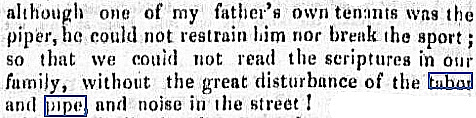
In 1837 in a newspaper article describing the Betley Window, the pipe and tabor player is described as 'the piper' 1851
"a man once came over from Finstock, named Dore who used to play dub and whittle"
wrote Cecil Sharp in his ' notes ' . In 1851 another note was made that in Finstock a fiddler was
" Living adjacent to piper Stephen Dore". So the 'piper' was a pipe and tabor player.1864 Sir Gilbert Scott recalled that at Christmas time when he was a child:
'Besides the usual carol singers and hymn singers who went from house to house I recollect we were always visited by a piper a little before Xmas', but later he adds that"the instrumental combination of three-holed pipe and tabor drum was a rare one"
British Architectural Library, Manuscripts and Archives Collection, Sir George Gilbert Scott Papers, Sc GGS/3, notebook 1, 'Personal & Professional Recollections', f. 27, written 22 January 1864; published in Recollections of Nineteenth-Century Buckinghamshire, p. 18
1888 'The Pied Pipe of Hamelin' poem:
The musician was called a piper - "Into the street the Piper stept .. "
The instrument he played was a pipe - "at the scarf's end hung a pipe "
Near the end the poem :"The place of the children's last retreat,
They called it the Pied Piper's Street,
Where any one playing on pipe or tabor
Was sure for the future to lose his labor"by Robert Browning
‘A Dictionary of English Folklore’ JACQUELINE SIMPSON STEVE ROUD, 2000 online here
‘Musical instruments; a comprehensive dictionary’ by Marcuse, Sibyl
"Westbury, Bucks: Mrs. Johnson (nee Makepace). Her father used to play pipe and tabor, for Brackley
dancers and for Westbury Morris, but seemed doubtful whether Westbury had an independent Morris
of its own. Her father died 40 years ago then the Brackley men got another pipe and taborist. ""Barton Hartshorne, Bucks.
George Horwood (80) remembers Morris in Barton and Chetwode- 70 years ago. A cousin of his
of the same name used to play the pipe "three fingers and drum"1679 play
“…I'me sure there will be no sport there till Tom Ticklefoot comes with his Tabour and Whistle..."‘Clod-pate's ghost, or, A dialogue between Justice Clod-Pate and his [quondam] clerk honest Tom Ticklefoot wherein is faithfullly
related all the news from purgatory, about Ireland, Langhorn, &c’ by Smith, Francis

top of page