|
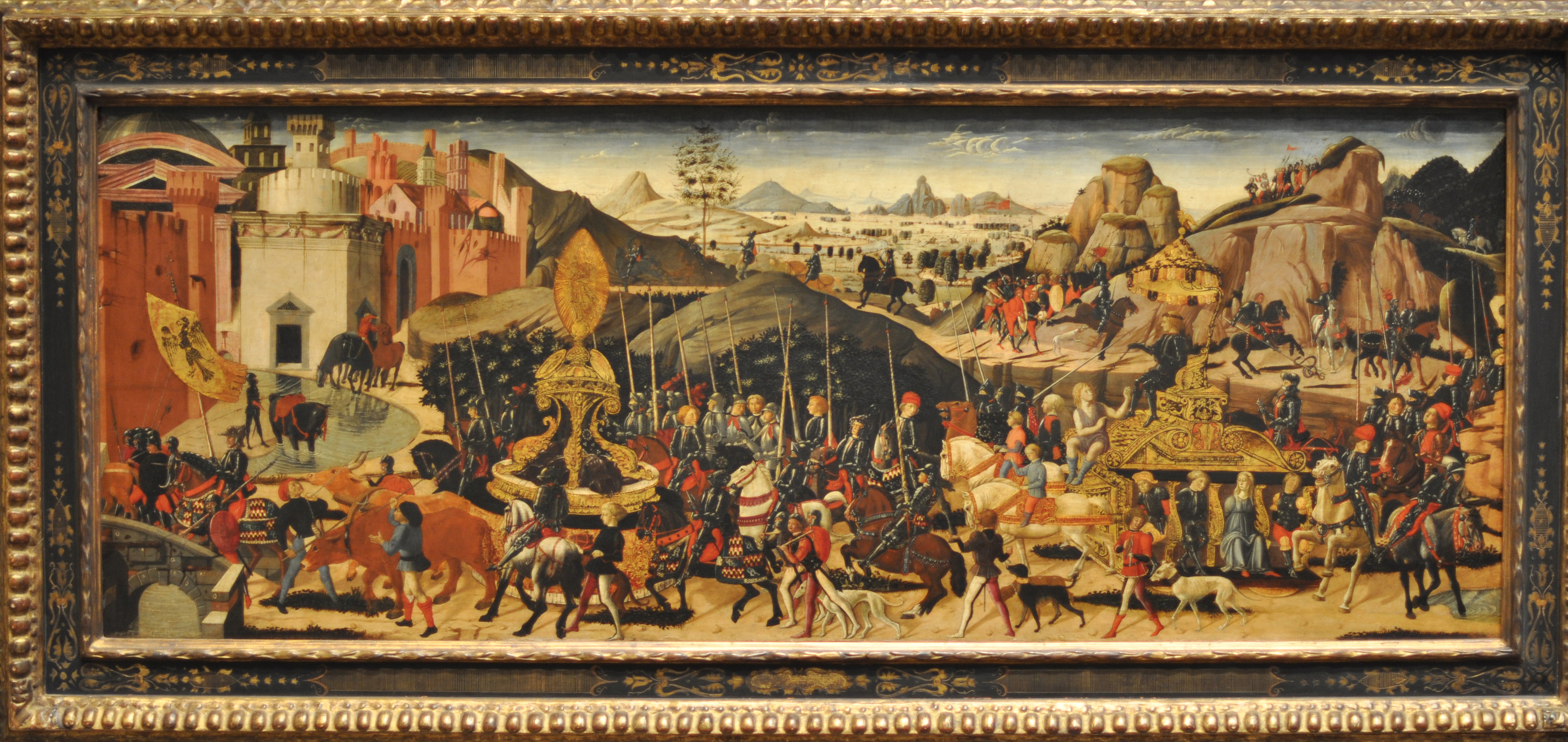
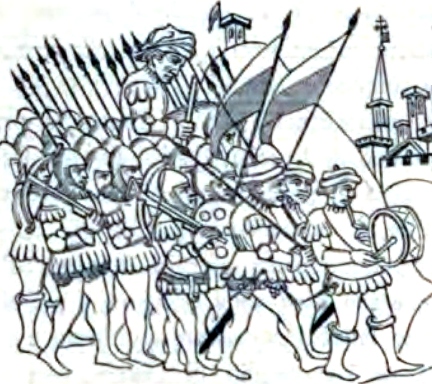
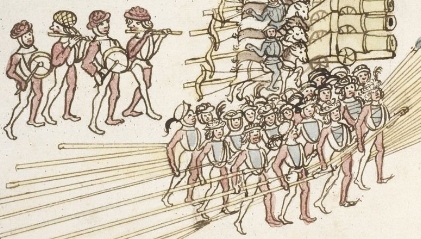
Sailing ships of all European countries seem to have carried at least one pipe and tabor player. Their job was to signal
between ships, give the sailors exercise to keep them fit and well and in good humour, and also to help introduce
mariners to any natives they came across in their explorations. The other usual instrument taken to war was a trumpet.
On land the rythmn of these instruments kept the soldiers in line as they advanced upon the enemy. |
|
| |
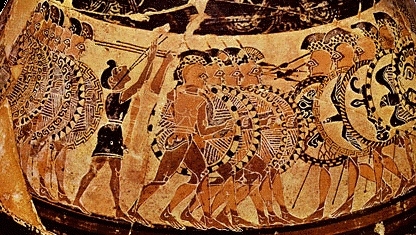 7th century BCE
Vase. In the earliest times an aulos player kept the Greek soldier's
feet
in step. 7th century BCE
Vase. In the earliest times an aulos player kept the Greek soldier's
feet
in step. |
Thucydides describes the Spartans
advancing to battle "slowly, to the
music of many pipers, as is their
established custom, ...so that their
approach should be even and rhythmical
and their line not broken..." |
1191 Description of the Saracen Army:
“In front came certain of their admirals, as was their duty, with clarions and trumpets; some had horns,
others pipes and timbrels, gongs, cymbals and other instruments, producing a horrible noise and clamour.
The earth vibrated from the loud and discordant sounds, so that the crash of thunder could not be heard amid
the tumultuous noise of horns and trumpets. They did this to excite their spirit and courage, for the more violent
the clamour became, the more bold were they for the fray.”
‘Itinerarium Peregrinorum et Gesta Regis Ricardi’ |
1191, after the
capture of Acre, Richard I distributed
among the "heralds, disours, tabourers, and trompours,"
who accompanied him, the greater part of the money,
jewels,
horses, and fine robes which had fallen to his share.
'Romance of Richard Coeur de Lion' 1911 |
|
|
| |
 |
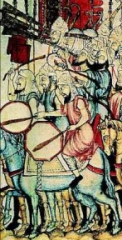 1280 trumpets and drums in Syrian battle 1280 trumpets and drums in Syrian battle |
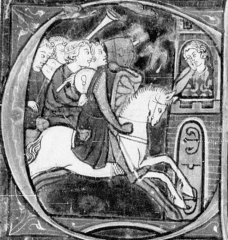
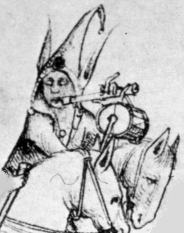
| 1250-1275 taborer on horseback, decorated initia in illuminated manuscript,l France |
"In 1277 An Englishman from St. Remy is serving the Commune of Florence together with 100 knights from abroad.
Amongst them there should be two drums with pipes or two trumpets, with the same wages as a knight."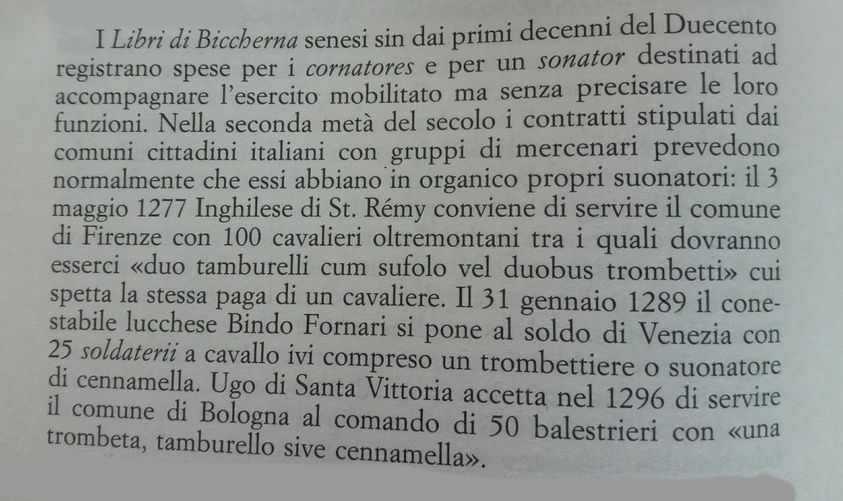 A. Settia, Battaglie Medievali, Il Mulino (publishing house), 2020 A. Settia, Battaglie Medievali, Il Mulino (publishing house), 2020
"The Sienese Biccherna Books since the first decades of the thirteenth century record expenses for cornatores
and a sonator intended to accompany the mobilized army but without specifying their functions. In the second
half of the century, the contracts stipulated by ordinary Italian citizens with groups of mercenaries normally provide
that they have their own musicians: on 3 May 1277 Inghilese di St. Rémy agrees to serve the municipality of
Florence with 100 ultramontane knights among whom they will have to be there two drums (taborers?) with
a flute or two trumpets who are entitled to the same pay as a knight. On 31 January 1289, the Lucchese
constable Bindo Fornari placed himself in the pay of Venice with 25 soldiers on horseback, including a trumpeter
or cennamella player. Hugh of Santa Vittoria accepts in 1296 to serve the municipality of Bologna in command of
50 crossbowmen with a trumpet, drum (taborer?) sive cennamella."
|
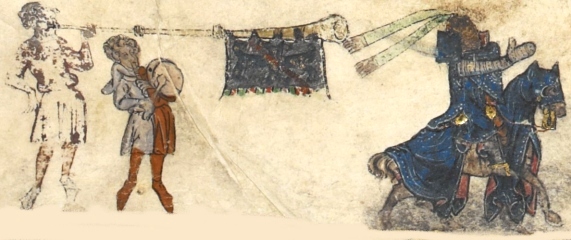 "The Romance of Merlin" (anonymous Middle English verse romance with battles) "The Romance of Merlin" (anonymous Middle English verse romance with battles)
describes "Trumpés beting, tambours classing" |
|
|
c l300 Rob. of Glouc.
"Of trompes & of tabors the sarazins made there
So gret noyse that cristinemen al destourbed were".
'Dictionary of Middle English Musical Terms'.Carter, H.H. (1961/1980) Indiana University Press, Bloomington. Reprinted (1980). |
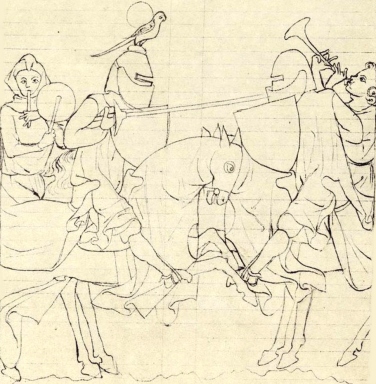 1300-1340 Zurich, Switzerland 1300-1340 Zurich, Switzerland |
In 1340 at the sea Battle of Sluys between England and France “...and when the fleet of France beheld this,
they loosened themselves from their heavy chains to pursue us. And forthwith our ships turned back upon them,
and the mêlée began, to the sound of trumpets, nakers, viols, tabors, and many other kinds of minstrelsy....” [source] |
Edward III of England was in Flanders during July 1345, and in France from July 1346, until October 1347. His
minstrels are what one would expect to find in a military expeditionary force of the period; there are five trumpeters
two clarioners, five pipers, a nakerer and a taborer. |
1363 In the Palazzo Pubblico in Siena, Italy:
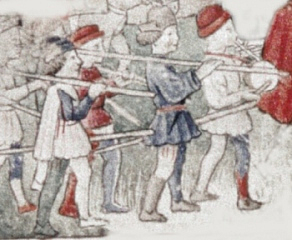
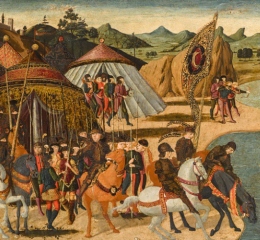
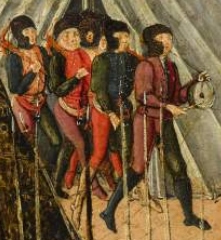
a mural painting depicts the victory of the Sienese troops at Val di Chiana. In front of the crossbow troops and behind the horses and trumpeters walk three taborers. |
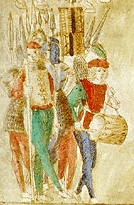
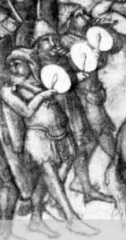 leading the soldiers leading the soldiers |
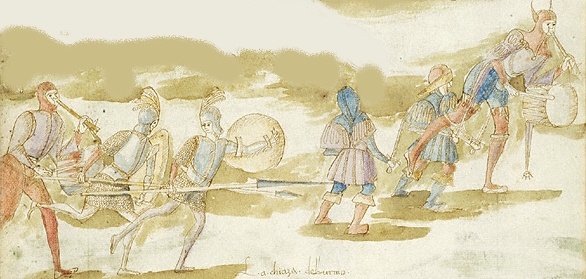
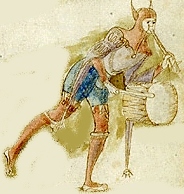
A modern researcher has documented the use of the pipe and tabor in Italian foot regiments during the fourteenth and fifteenth centuries.
[Gianni Lazzari reproduces pictures of military pipes and tabors from the fourteenth, fifteenth and sixteenth centuries, not only in Italy but in other European countries as well; see his ‘L’uso Militare del Flauto a Tre Buchi e Tamburo’, SIFTS 3, 1 (1998), 15-32]
The military use of the three-hole flute and drum.
|
|
 1380-1400 Caesar crossing the Rubicon, Paris France 1380-1400 Caesar crossing the Rubicon, Paris France |
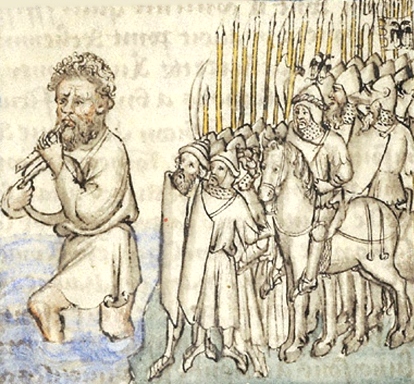 1390-1399 France Crossing the Rubicon 1390-1399 France Crossing the Rubicon |
1400 in Chaucer’s “Knight’s Tale”
“The trumping and the tabouring,
Did together the knights fling.” |
|
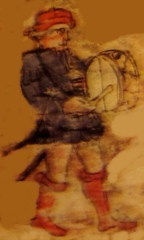
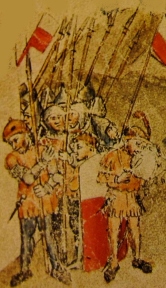 1368-1424 Italy 1368-1424 Italy
leading the foot soldiers
|
 |
 |
 |
|
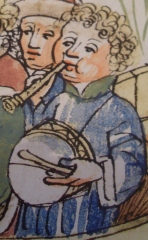
1440 - 1450 'The Life and times of the Emperor Sigismund'
|
|
 |
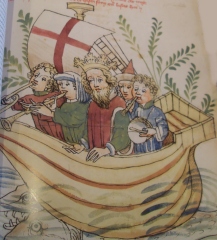
the army. One galleon crossing the sea is accompanied by a king.
In the stern of this ship is a pipe and tabor player. |
|
|
|
 |
|
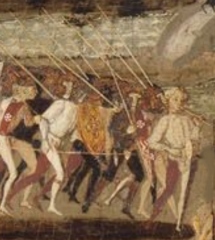 1460 Italy, Seige of Pisa: 1460 Italy, Seige of Pisa: |
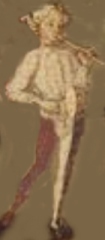 close-up of player close-up of player |
 1475-1480 Italy, accompanying the infantry: 1475-1480 Italy, accompanying the infantry: |
 close-up of player close-up of player |
|
|
|
|
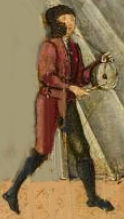 |
1474 " Sodaynly he herd at the poort a passing grete noyse & bruyt of trompettes clarions and tabours of the grekes"
'Dictionary of Middle English Musical Terms'.Carter, H.H. (1961/1980) Indiana University Press, Bloomington. Reprinted (1980). |
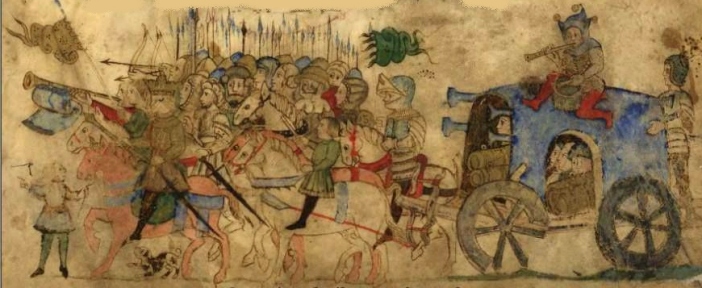 1479 Italy, Pharoah’s armies pursuing the Israelites to the shores of the Red/Reed Sea. 1479 Italy, Pharoah’s armies pursuing the Israelites to the shores of the Red/Reed Sea. |
1481 England:
Alongside an extensive list of armour and items needed for an army, from a ship called Mary,
is imported "1 doz tabor pipes"
Petty Custom Account 1480-1: Imports, Apr - June 1481 |
1481 a payment was made on "9 May: 12d to the taborets of the Spaniard" -
The great Spaniard,
the “Mary” of Greenwich, was one of the ships patrolling the English Channel. |
|
|
1498 Christopher Columbus was exploring South America and found
some local people in the islands of the West Indies:
"
a canoe followed the admirals ship, having twenty-five men on board,
and stopped at the distance of a cannon-shot, calling out and speaking
very loud.....As they could not be induced to come on board, .....
the admiral ordered some young fellows to dance on the poop to the
music of a pipe and tabor. On seeing this, the Indians snatched up their
targets, and began shooting their arrows at the dancers; who, by the admirals command, left off dancing and began to shoot with their cross-bows in return" |
There are two versions of this story.
His son wrote:
“Then the Admiral tried to lure them
by staging a show, with a pipe-and-tabor
player mounting the prow,while another
sang and played a kettle-drum
and some grummets did a dance.” |
1498  ‘The West Indies’ Chapter LXIX ‘The West Indies’ Chapter LXIX
‘A Collection of voyages and travels :some now first printed from original manuscripts: others translated out of foreign languages and now first publish'd
in English: to which are added some few that have formerly appear'd in English, but do now for their excellency and scarceness deserve to be reprinted’ |
|
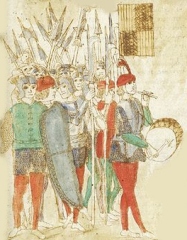 1498 Spanish soldiers 1498 Spanish soldiers
lead by a pipe aand tabor player
|
|
|
|
1498 Spanish ( Aragon) soldiers |
|
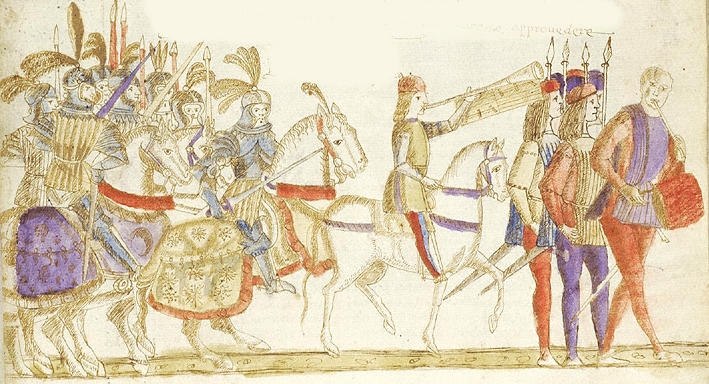 1498 The Aragonese army is lead by the taborer 1498 The Aragonese army is lead by the taborer |
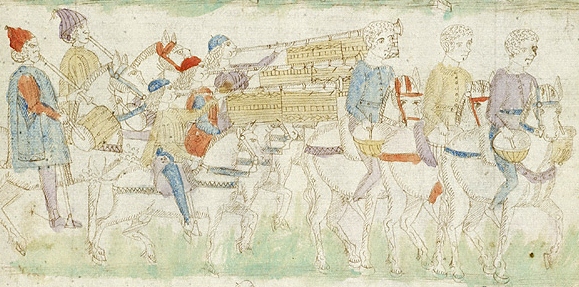 1498 Two mounted pipe and tabor players as part of a loud band 1498 Two mounted pipe and tabor players as part of a loud band |
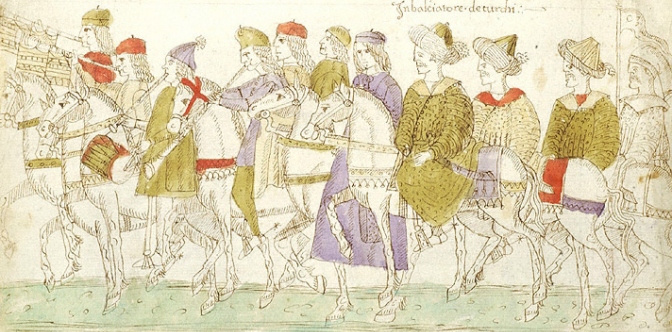 1498 pipe and tabor player on horseback forms part of the party accompanying the Turkish Ambassador 1498 pipe and tabor player on horseback forms part of the party accompanying the Turkish Ambassador |
|
|
The Spanish (?) army arrives to invade the Canary Islands with a trumpeter and a pipe and tabor player
at the front. |
|
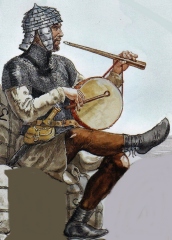 late 15th century Dithmarschen late 15th century Dithmarschen
[now part of Germany] militiaman.
copyright Osprey |
|
| 1498 |
 |
|
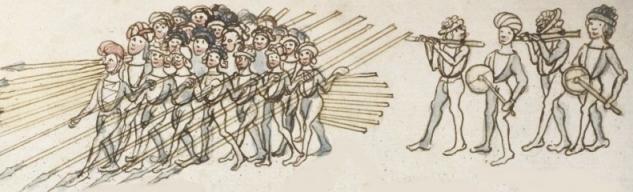
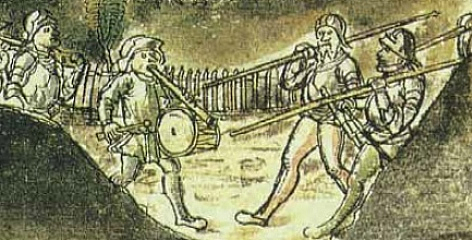
At the same time as the pipe and tabor
played by one person was in use,
the duo of flute player and drummer
was
also used in armies.
1496 German
manuscript shows two
pairs of the latter
musicians, one set on
each side in battle
formation. |
1502 Scotland: Taborers were paid by the job
for working at Court events:
payments made to taborers from the King’s accounts:
28 May: 14.0d to the taborers of the “Jacat”.
[James IVwas inspecting his ships in the Firth of Forth]
7 July, on board the “barge of Dundee”: 14.0d to the taborer of the said ship.
1503 6.0d to the taborer of Robert Berton, in the ship |
1513-1528 Professional musicians mentioned in documents related to the armada of Pedro Arias Dávila,
Governor of Castilla de Oro
from Spain to south America included:, .
Alonso Barba tamborino (tabor pipe player)
Diego de León tamborino, (also an instrument maker)
Benito de Bejer tamborino, pífaro/ pífano
In the years between 1490 and 1510 the most frequently paid minstrels were those that played
harp, lute, vihuela, rebec, pipe and tabor or douçaine (dulzaina)
Trumpets, Gold, Minstrels and Death Music and the Armada of Pedro Arias Dávila in Castilla de Oro (Eastern Panama-Northwest Colombia)
1513-31 by Egberto Bermúdez |
 |
 |
1542 Battle of Cascina, Italy (which took place in 1364) |
|
1568  'English Musicians in the Age of Exploration' by Ian Woodfield 'English Musicians in the Age of Exploration' by Ian Woodfield |
 1545 King Henry VIII's flag ship the Mary Rose sunk just off the southern shore of England. 1545 King Henry VIII's flag ship the Mary Rose sunk just off the southern shore of England.
Three tabor pipes were found in the ship when it was lifted. This one is a boxwood pipe made by the Bassano family.
This family of Italian musical instrument makers had relocated to London at the invitation of King Henry VIII. |
A description of the items every Elizabethan ship carried which included armaments: ‘Russia at the Close of the Sixteenth Century. Comprising, the Treatise "Of the Russe Common Wealth" by Sir Jerome Horsey page 186 ‘Russia at the Close of the Sixteenth Century. Comprising, the Treatise "Of the Russe Common Wealth" by Sir Jerome Horsey page 186
|
1582 English East Indies exploration:
"Orders: M. Edward Fenton Esquire, for the order to be observed in the voyage recommended to him
for the East Indies and Cathay. Aprill 9. 1582.
“Day 21: the generall in his pinnesse with, his musicke, & trumpets; and I in my skiffe with trumpets, drum and fife,
and tabor and pipe, accompanied them a mile up the river: “
‘Hakluyt's collection of the early voyages, travels, and discoveries of the English nation ‘by Hakluyt, Richard, 1811 |
early 17th century: Captain Middleton exploring Africa for the East India Company:  ‘English musicians in the age of exploration’ by Woodfield, Ian, 1995 ‘English musicians in the age of exploration’ by Woodfield, Ian, 1995 |
1613 'The voyage of Captain John Saris to Japan', 1613 'The voyage of Captain John Saris to Japan', 1613 |
1615 Spanish conquistadors in the New World, circa 1530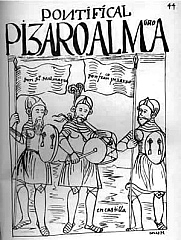 the indigenous Andean man, don Felipe Guaman Poma de Ayala, wrote an extensive letter in pen and ink addressed to the Spanish king the indigenous Andean man, don Felipe Guaman Poma de Ayala, wrote an extensive letter in pen and ink addressed to the Spanish king
(Philip II, then Philip III): 'The First New Chronicle and Good Government' ( El primer nueva corónica y buen gobierno |
1703 letter
From the Castle of Bermuda: Mr. Larkin to the Council of Trade and Plantations.
“I know your Lordships will never pass sentence on me before you hear me.“…came into the Islands
a fidler in a Pyrates' ship, advised and persuaded the Justices to the contrary….”
|
|
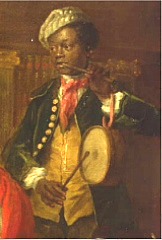 |
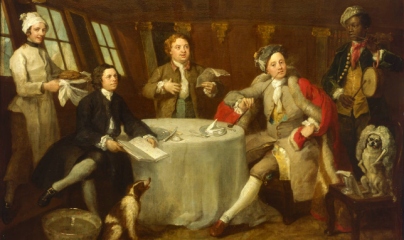
1745 Captain Lord George Graham, in his Cabin: Captain Graham returned from a voyage ill. The music from pipe and tabor may have helped with the cure. |
|
1765 France  ‘The memoirs of a protestant, condemned to the galleys of France, for his religion. Written by himself. ... In two volumes. ... ‘The memoirs of a protestant, condemned to the galleys of France, for his religion. Written by himself. ... In two volumes. ...
Translated from the original, just published at the Hague, by James Willington.’ 1765: Vol 2
by Marteilhe, Jean |
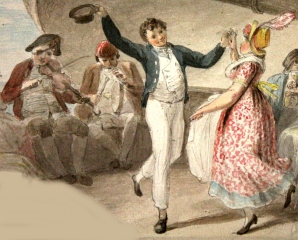
c. 1790 sailors dancing, printed fabric, France 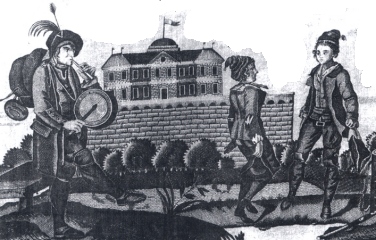 |
|
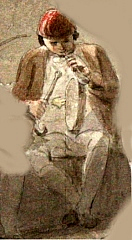 |
1795 story -
‘The Bear and other Beasts.’
“…The fidler, or rather the performer on the pipe and tabor, was considered as a fit subject for his Majesty's navy,
and consequently sent to a regulating captain, who forwarded him and his vile instrument of noise on board….”
‘Sporting Magazine of Monthly Calendar Of the Transactions of the Turf the Chase, and every other Diversion
interesting to the Man of Leisure, Enterprize and Spirit.’ |
1814 the convict ship Broxbornebury (England to Australia) records accounts of convicts dancing to fife and drum.
Monday 28th March
This evening the convicts danced to the piper.
Tuesday 5th April
This Evening the convicts danced to a Drum and Fife. – One of the Crew plays very well.
Friday 24th May p 56
We had a really fine day, but the wind headed us little and after Dinner we had the drum and fife as usual;
Thursday 26th May
This Evening and last evening we had dancing on the Deck. The Drum and Fife played for an hour. |
1816 essay
“…the youth of both sexes, to whom the pipe and tabor in England, or the bagpipe in Scotland, would have been
in themselves an irresistible temptation,… To compel men to dance and be merry by authority has rarely succeeded,
even on board of slave-ships, where it was formerly sometimes attempted by way of inducing the wretched captives
to agitate their limbs, and restore the circulation, during the few minutes they were permitted to enjoy the fresh air upon deck….”
‘Tales of my Landlord [1st series]’
by Scott, Walter, Sir |
1817 clinical advice for sailors: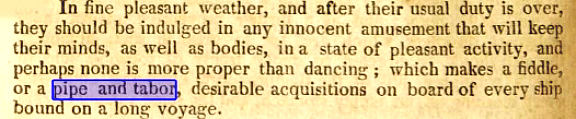 ‘The modern practice of physic : exhibiting the characters, causes, symptoms, prognostics, morbid appearances, ‘The modern practice of physic : exhibiting the characters, causes, symptoms, prognostics, morbid appearances,
and improved method of treating the diseases of all climates’ |
1820 Dancing on convict ships.
The 'Guildford' transported 190 convict men to the colony, from England to Australia (15 April 1820 to 5 November 1820).
Surgeon-superintendent, Hugh Walker reported that no convicts died on the voyage and commented on their remarkable
health which he attributed to cleanliness, ventilation and daily mustering on deck. In his medical journal he recommended
that convict ships should carry pipes and tabors so that convicts may dance to prevent them brooding on their misfortunes.
'Medical Journal of Hugh Walker on the voyage of the Guildford in 1820.' The National Archives. Kew, Richmond, Surrey. |
1822 advice on preventing scurvy  'The modern practice of physic : exhibiting the character, causes, symptoms, prognostics, morbid appearances, 'The modern practice of physic : exhibiting the character, causes, symptoms, prognostics, morbid appearances,
and improved method of treating the diseases of all climates'
by Thomas, Robert, Hosack, David, |
1823 Advertisement  Morning Advertiser - Tuesday 11 February 1823 Morning Advertiser - Tuesday 11 February 1823 |
1837 story: extract from
‘THE OLD COMMODORE’
.”Here is a naval tale in three volumes … It is a work of great interest, combining scenes of novel
and exciting description, both ashore and afloat”
 Weekly Dispatch (London) 24 September 1837 Weekly Dispatch (London) 24 September 1837 |
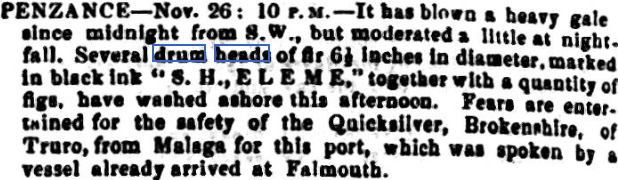 Shipping and Mercantile Gazette - Tuesday 28 November 1843 Shipping and Mercantile Gazette - Tuesday 28 November 1843 |
1859 story: 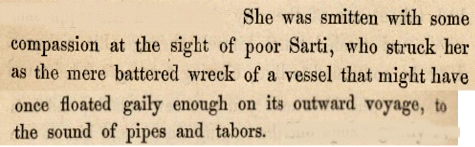 ‘Scenes of Clerical Life’ by Eliot, George ‘Scenes of Clerical Life’ by Eliot, George |
1881 The Household Cyclopedia of General Information - a handbook of the practical and domestic arts
of America in Victorian times, regarding sailors:
"... they should be indulged in any innocent amusement that will keep their minds as well as bodies in a state
of pleasant activity, and perhaps none is then more proper than dancing. This makes a fiddle or a pipe and
tabor desirable acquisitions on board of every ship bound on a long voyage." |
| |
|
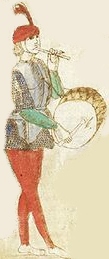
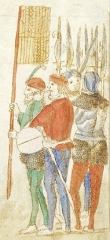
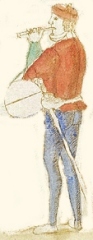

 leading the soldiers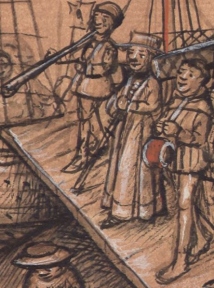
,_formello,_tumulo_di_monte_aguzzo,_640_ac_ca._01.jpg)