 15th century religious plaque 15th century religious plaque |
 1456 manuscript, Gemini, 1456 manuscript, Gemini,
treatise on astrology,
translation
of 'Liber de nativitatibus' |
|
Throughout the 16th and 17th centuries the drum and three-hole pipe formed an inseparable part of Catholic
Corpus Christi processions and dances. They accompanied countless parades, until new fashions and instruments
displaced
this ancient couple
to the most remote corners. This ritual use favoured the export of its practice to South America.
In many parts of Spain this tradition continues up until the present time. Some people believe, however,
that the pipe
and tabor are old fashioned
and now hire a brass band for events instead. |
“Taborers have always been solitary musicians, both because of the difficulty of agreeing on an interpretation
that includes improvised ornamentation, never written down and always different in some detail, and because
of the coincidence of the tunings on instruments manufactured in isolation. Taborers are animators of traditional
dances and as preservers and creators of an ancient repertoire…”
‘DULZAINA, GAITA AND FLUTE, THREE POPULAR INSTRUMENTS
Brief introductory study to a collection of ‘New music for old instruments’ |
| Images and descriptions of three-hole pipes across Spain in the 21st century here |
1604 giants procession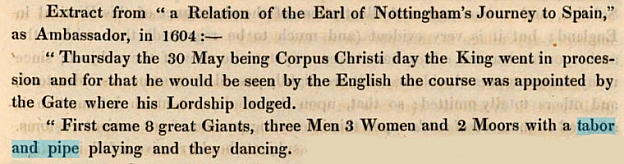 ‘Dissertation on the Pageants or Dramatic Mysteries anciently performed at Coventry by trading Companies of that city’ by Sharp, Thomas, 1825 ‘Dissertation on the Pageants or Dramatic Mysteries anciently performed at Coventry by trading Companies of that city’ by Sharp, Thomas, 1825
|
1819 English newspaper letter to the editor: 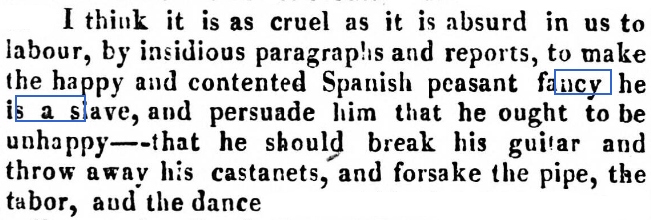 Morning Post - Tuesday 12 January 1819 Morning Post - Tuesday 12 January 1819 |
1821 English newpaper comment:  Saint James's Chronicle - Tuesday 05 June 1821 Saint James's Chronicle - Tuesday 05 June 1821 |
1839 English newspaper report on a Spanish procession: 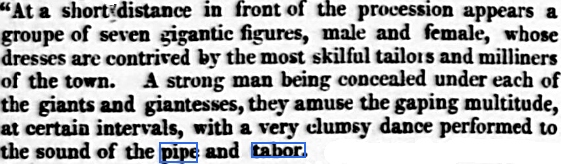 Leicester Journal - Friday 07 June 1839 Leicester Journal - Friday 07 June 1839 |
1842 English newspaper report on Spanish townspeople dancing:  Morning Chronicle - Wednesday 28 December 1842, England: Morning Chronicle - Wednesday 28 December 1842, England:
article repeated in Australia - Morning Chronicle (Sydney, NSW) Wednesday 13 March 1844 - page 4 |
1877
In a Spanish provincial hospital chapel service on New Year’s Day:
“pipe and tabret are not wanting”
‘Among the Spanish People’ : In 2 Vols.. II by Rose, Hugh James |
| |
|
|
|
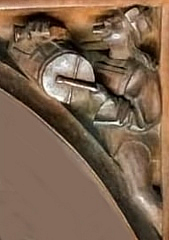
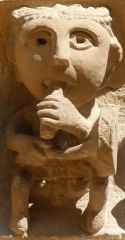
 12th century church of Santiago 12th century church of Santiago
de la Corona, Zaragoza [possible] |
|
|
|
14th century
music in the Crown of Aragon:
Constitution of the Royal House of Aragon, drafted under the reign of Peter IV (1319-1387):
“In the courts of princes, according to ancient custom, minstrels may duly be the heart of their profession,
providing a joy that princes should desire and maintain with honesty.
Through this joy, they distance
themselves from sadness and anger, always showing themselves to be more amiable.
Therefore,
we order that in our court there be four minstrels: two of them will be troubadours, the third will
be a tamborilero, and the fourth will play the trumpet. In their profession, these minstrels will entertain
us while we eat, at the beginning of the meal, and also during the meal. If there are foreign minstrels
or our own musicians playing instruments at the end of the meal, we also want to listen to them.”
Music and Courtly Culture in the Time of the Catholic Monarchs’ by Francisco Parralejo Masa, 2025 |
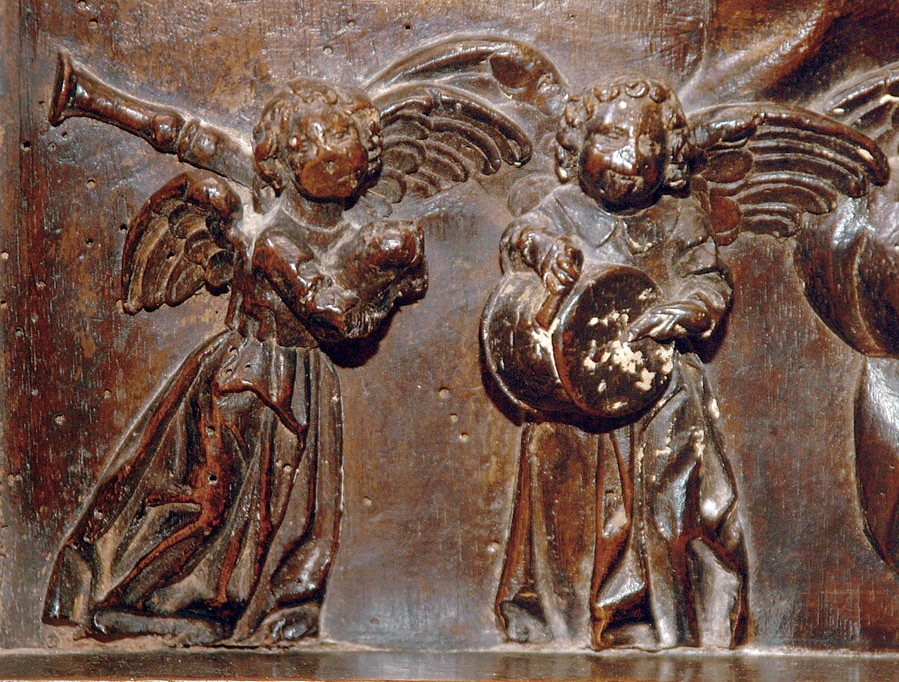
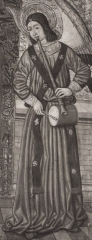 15th century angel painting 15th century angel painting
[similar copies elsewhere in Spain] |
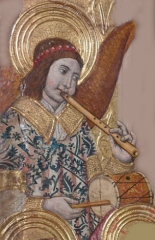 1482 - 1485 angel painting, alterpiece convent
of San Francisco de Barbastro 1482 - 1485 angel painting, alterpiece convent
of San Francisco de Barbastro |
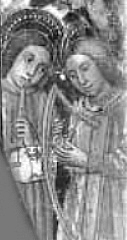 15th century angels, altarpiece Calatayud, Zaragoza 15th century angels, altarpiece Calatayud, Zaragoza |
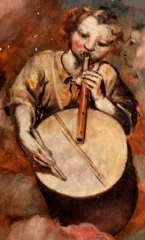 17th century Convent of the Immaculate Conception,
Épila, Zaragoza 17th century Convent of the Immaculate Conception,
Épila, Zaragoza |
|
|
| string drum and chiflo Chiflo y salterio, tamborino de cuerdas |
|
1902
“...Six young men with legs of steel and well-tempered lungs came dancing
to the sound
of a whistle and a psaltery and their castanets, a strange,
very original dance...” |
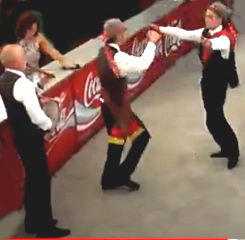
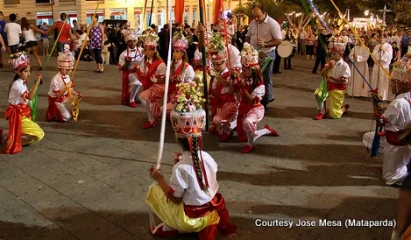
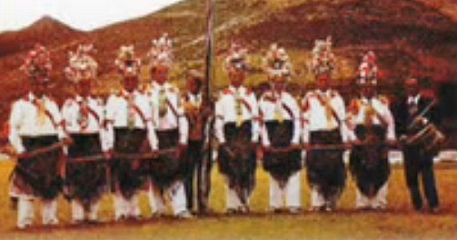
 1959 Dancers from Jaca at the 3rd Aragonese Dance Competition; page 50 1959 Dancers from Jaca at the 3rd Aragonese Dance Competition; page 50 |
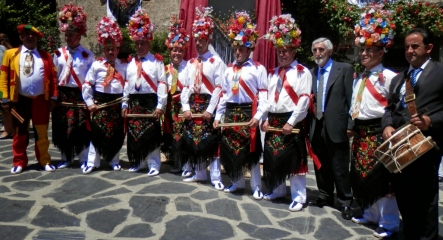
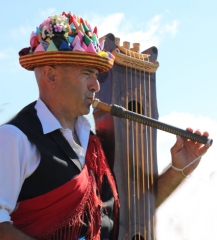 21st century, string drum and chiflo playing 21st century, string drum and chiflo playing
for annual Dance of Santa Orosia, Yebra de Basa, Huesca |
 2021 playing in church, Jaca 2021 playing in church, Jaca |
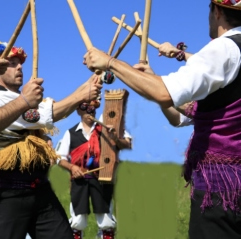 dance at pilgrimage in Yebra de Basa, Huesca dance at pilgrimage in Yebra de Basa, Huesca |
|
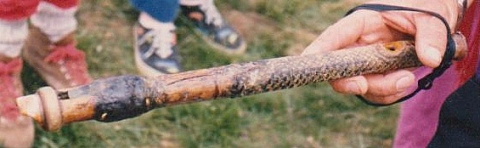
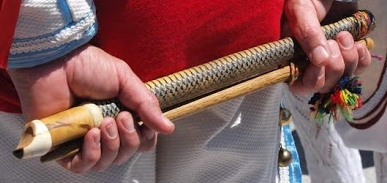
 chiflo played with the string drum chiflo played with the string drum |
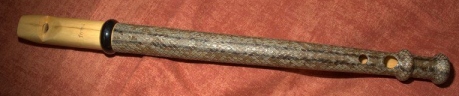 chiflo of boxwood completely covered with snake skin; horn mouthpiece chiflo of boxwood completely covered with snake skin; horn mouthpiece |
|
|
|
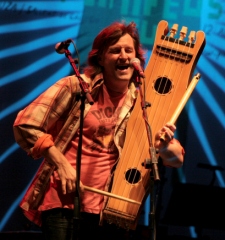 chicotén; the band Biella Nuei chicotén; the band Biella Nuei
plays traditional
music of Aragon |
| |
|
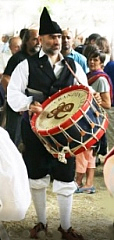
| pipe is a xipla, the player is called a tamburiteiru or atambor (from 16th century) |
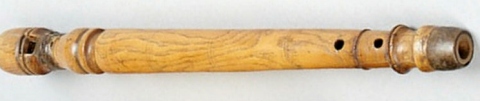 xipla |
|
"In the municipalities of Cangas del Narcea, Degaña and Ibias ...." Although the word "xipla"
can only be found
in oral tradition, the expression "atambor", equivalent to "tamburiteiru", appears since the 16th
century in written
documentation from the Cathedral of San Salvador in Oviedo and seems to refer not to a drum
alone, but to the
drum and flute ensemble in the hands of a single musician who takes his name from the percussion
instrument."
Ricardo Cuesta. Muséu del Pueblu d'Asturies |
|
|
|
|
| |
| Toledo |
 1280-1300 stone carving 1280-1300 stone carving
Cathedral Pueto del Reloj |
|
|
Around 1431, Constable Don Álvaro de Luna received the King in his palace in Escalona. At a banquet
“…The stewardesses entered with the delicacies, carrying before them many minstrels and trumpets
and tambourinos: and thus the table of the King was served,…”
'FLUTE PLAYERS, TAMBORINOS, XABEBAS AND FIFANS FROM CASTILLA AND
FLANDERS AT THE DAWN
OF THE RENAISSANCE' by
Ana LOPEZSUERO |
1448 meal entertainment for King John II of Castile when he visited Escalona. The meal was presented:
“with many minstrels, trumpets, and tamborinos before them … After the tables were cleared, those
young knights danced with the maidens”
‘Music and Courtly Culture in the Time of the Catholic Monarchs’ by Francisco Parralejo Masa, 2025 |
|
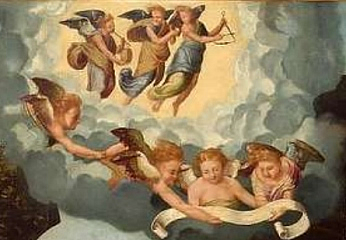
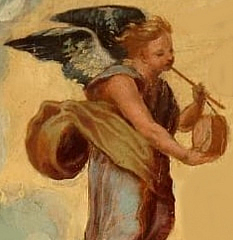 16th century painting; detail of heaven 16th century painting; detail of heaven |
| |
|
|
|
Galicia |
|
 late 15th century, stone carving late 15th century, stone carving
Ourense Cathedral |
|
 1550 painting, church of Santa Baia de Banga 1550 painting, church of Santa Baia de Banga
Ourense |
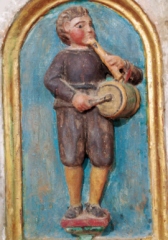 16th century altarpiece of the church 16th century altarpiece of the church
of St. Maria de Meiraos, Lugo |
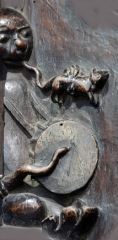 1624 allegory, choir stall 1624 allegory, choir stall
Lugo Cathedral |
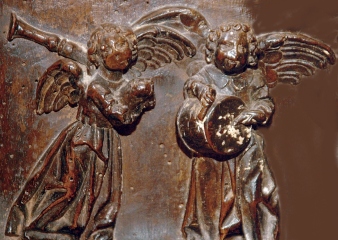 1647 wood carving, choir stall, San Martiño Pinario 1647 wood carving, choir stall, San Martiño Pinario
(Santiago de Compostela)
(upper part of pipe missing) |
 18th century
Monastery of Saint Pelagius of Antealtares,
Santiago de Compostela 18th century
Monastery of Saint Pelagius of Antealtares,
Santiago de Compostela |
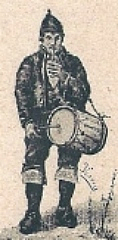 1897 Galicia Moderna magazine
Pontevedra 1897 Galicia Moderna magazine
Pontevedra |
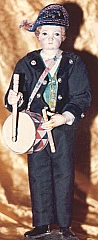 statuette statuette |
|
'The young people of Loña - from a poem by Carlos Rei:
“they dance the gavotte,
than the old piper
e plays it very well.
They dance the gavotte,
plus the windbreaker,
how well he plays them
the old piper”
…
The shepherds, in orchestra,
they make the main party,
with flutes and drums
oh heavenly boy" |
|
|
|
Madrid |
1502 Count Antoine de Lalaing, chamberlain and chronicler to the Archduke, described the entry of the future
monarchs into the town of Madrid :
“On Wednesday, April 27, 1502, the Duke of Infantado arrived, accompanied by three hundred horses and sixty
to eighty mules; …. The said Duke came accompanied by trumpets, and pipe and tabor players”
‘Flautistas, tamborinos, xabebas y pífanos de Castilla y Flandes en los albores del Renacimiento’, in Musicología en el siglo XXI: nuevos retos,
nuevos enfoques' by Ana López Suero, 2018 |
1526 the Italian Juan de Garamendi was appointed at court with the designation as ‘ministril de la flauta y tamborino’ |
Between 1526 and 1539 Juan Sanchez was the court tamborino /tanedor de la flauta (page 36 table) |
1605 THE RIGHT HONOURABLE CHARLES, EARL OF NOTTINGHAM, Lord High Admiral of England,
His Highness's Ambassador to the King of Spain : report of the journey: 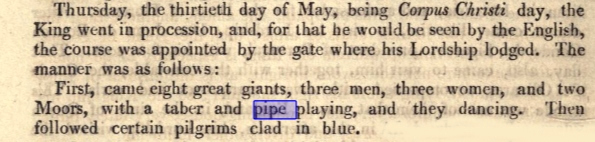 The Harleian Miscellany : or, A collection of scarce, curious, and entertaining pamphlets and tracts, as well in manuscripts as in print, The Harleian Miscellany : or, A collection of scarce, curious, and entertaining pamphlets and tracts, as well in manuscripts as in print,
found in the late Earl of Oxford's library; interspersed with historical, political, and critical notes
by Oldys, William; Malham, John, 1808 |
17th century an Englishman's letter, one day's journey from Madrid: 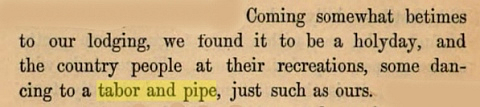 ‘The autobiography and correspondence of Sir Simonds d' Ewes during the reigns of James I and Charles I’. 2, by D'Ewes, Simonds, 1845 ‘The autobiography and correspondence of Sir Simonds d' Ewes during the reigns of James I and Charles I’. 2, by D'Ewes, Simonds, 1845 |
1670 translated Spanish story:
“…A while after, dyed one of the principal men of the parish, a Gentleman and of good Parentage: But a person
that would make a fool of himself, when he was in his Wine, so that being a little elevated, would go out upon a holy
-day with a Tabor and Pipe, to make merry and dance with the maids and young men of the Town, in a ridiculous manner…”
‘The Fortunate Fool' written in Spanish by Don Alonso Geronimo de Salas Barbadillo of Madrid |
 |
 |
 |
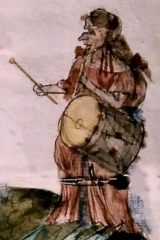 |
|
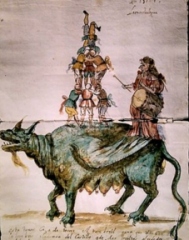
1672 'Tarasca' in the Corpus Christi Procession |
|
|
1786 Madrid, April 23rd: edict promulgated by King Charles III.
“…It is prohibited for the residents and inhabitants of Madrid, of whatever status, quality, and sex they may be,
to use tambourines, rattles, vocinas, zambombas, gaytas, conch shells, whistles, and other ridiculous instruments,
under the pretext of joy and rejoicing with which they celebrate the nights of San Juan and San Pedro; …”
Chronological collection of Royal Pragmatics, Decrees, Decrees, etc. of the Count of Campomanes, 17.
FEV-SV-G-00091, 12 |
1824 pipe and tabor ban: 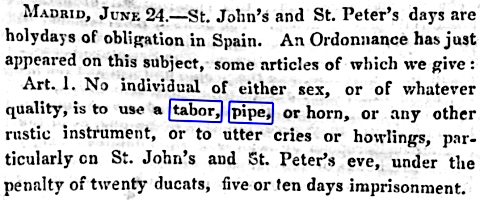 English Chronicle and Whitehall Evening Post 08 July 1824 English Chronicle and Whitehall Evening Post 08 July 1824 |
1834 report from an English traveller: 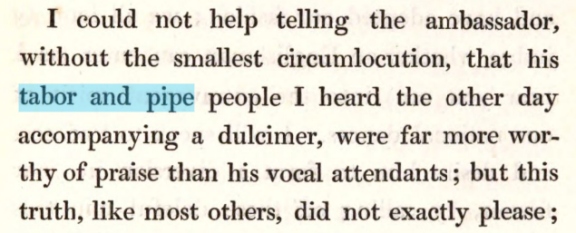 ‘Italy with Sketches of Spain and Portugal’ by Beckford, William ‘Italy with Sketches of Spain and Portugal’ by Beckford, William |
1878 observations on life in Madrid by an Englishman  ‘Letters of James Russell Lowell’ 2 pub. 1894 England ‘Letters of James Russell Lowell’ 2 pub. 1894 England |
|
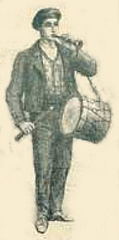 |
|
|
1911 piano music front cover printed in Madrid |
 1913 painting, street musicians 1913 painting, street musicians |
 2000 drawing 2000 drawing |
|
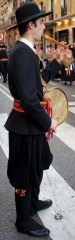 2015 player 2015 player
|
| |
|
Navarre - flauta y tambor |
In the Navarrese law courts recorded designations for the pipe-and-tabor player were juglar de tamborina,
juglar de tamborín, or simply juglar.
In the 15th century there are records of tamborinos playing in Corpus Christi processions. |
|
 Pamplona Cathedral Pamplona Cathedral |
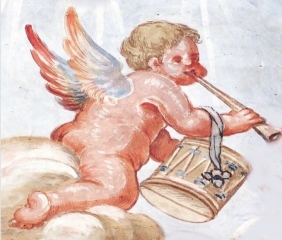 Los Arcos church of Santa Maria Los Arcos church of Santa Maria |
 1550 Oriz Palace freize, Elorz Valley 1550 Oriz Palace freize, Elorz Valley |
 Oriz Palace enlargement of player Oriz Palace enlargement of player |
 |
|
Engagements for taborers during the 16th and early 17th centuries were typically for specific, one-off performances.
At this time “the Corpus Christi festival was the occasion that most frequently called for tamborinos
alongside celebrations marking significant events within the royal family. Specifically, the births of princes, royal visits,
and the accession of Philip III prompted towns to hire minstrels or tamborinos, as well as dancers clad in jingle bells
and performing high leaps. The century closes with processions characterized by "abundant music from minstrels
and drums," and featuring the ‘ttun-ttun’ (string drum), as a percussion instrument accompanying the flute.”
1507 is the earliest documentary evidence of a flauta y tambor player in Navarre.
1507 In Tafalla Pedro ‘el Tamboril’ was hired by the town council to liven up the festivities for San Sebastián,
the city's patron saint.
1562 at a baptism in Sunbilla: Thirty or forty guests attended and the godfather
brought
twenty-one companions
among whom was Bernart de Ozate, "a drummer with his drum and flute."
1585 Irurita:
Many towns and villages had their own taborer. In 1585 Irurita: a large number of residents from the Baztan Valley
gathered to celebrate Easter Sunday with merrymaking, dancing, and rejoicing. Each group brought its own minstrel
—complete with drum and flute—resulting in a gathering of five or six musicians.
A notable lawsuit followed when:
“... to celebrate Easter a large number of residents of the valley gathered in the town
of Baztan to relax, dance
and rejoice. Each group brought its minstrel with his pipe and tabor so five or six gathered”
in one place.
A fight broke out, one taborer’s drum was kicked, which triggered a fight between two sides in which
weapons were drawn.
1595 Ordinances of the City of Pamplona stipulated that dances had to end four hours before supper
and could not be held in entryways or vestibules, even in rainy weather; they also mandated that the minstrel
stop playing his instrument the moment he observed any impropriety.
From the mid-17th century onwards the tabor player became a civil servant or public employee on a contract. |
18th century: the outset of this century saw a proliferation of condemnations from the Catholic hierarchy
—compounded by doctrinal missions led by Jesuits, Carmelites, and Franciscans—driven by an obsession
with the supposedly corrupting influence of ‘tamboril’ dancing. Punishments for those who violated standards
of propriety and decency included the tamboril player:
"if, after being warned, he plays that tune—or the rapid, frenetic passages used to conclude the dance—he shall
be immediately thrown into jail, where he will learn to play calmly rather than sounding the alarm."
In 1716 public dancing started to be regulated: it was prohibited during religious services and after nightfall.
The tamborilero could be punished with both fines and jail time.
However musicians, including taborers, were hired to accompany the city council on official outings to both
religious and secular events, the saint’s procession, and bullfighting festivities. They were also required to
enliven the streets during the morning hours. With the vogue for pastoralism by the aristocracy rural
and folk music and instruments became included in orchestral ensembles.
The desire to organize and control popular festivities led to a degree of standardization of both
instruments
and players. So in other parts of Spain there developed “a split into two modes or schools: that of rural
tamborileros (belonging
to an oral tradition—generally lacking formal musical training and preserving music
passed down through
generations—and that of 'txistularis' in larger towns and cities who were salaried
public employees with
musical training who performed music specifically composed for the txistu. However
in Navarre the practice of contracting players for individual performances remained the norm. |
19th century municipal bands of txistularis were established. They would become
the cornerstone
of the instrument's future.
1816 For the San Fermín festivities taborers from outside the town provided the music, one of them
specifically to accompany the giants.
It was a requirement to obtain prior authorization to hire a taborer for any event from the municiple authorities.
This was no trivial matter as unauthorized hiring was severely punished. Also there was still pressure on taborers
to uphold
morality and order when they played. By the end of the 19th century, lacking power and supplanted
by bagpipes, brass bands, quintets, and accordions, the txistu no longer captured the attention of young people,
nor did it even provoke the sort of bawdy revelry it once had. |
1838 English newspaper music review: 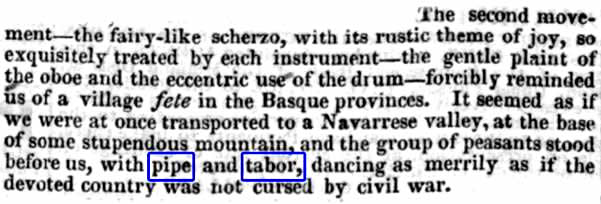 London Evening Standard 24 April 1838 London Evening Standard 24 April 1838 |
1839 English newspaper report on a dance display, Pamplona: Morning Chronicle 28 September 1839 Morning Chronicle 28 September 1839 |
In the Navarrese pre-Pyrenean valleys—characterized by very small settlements—it can be said that the txistu
remained the dominant instrument for patron saint festivals until the second decade of the twentieth century.
It was subsequently replaced by the bagpipe, the accordion, or brass quintets. Up until this time family dynasties
have been numerous in the history of the Basque txistu.
1918, the Society of Basque Studies (Eusko Ikaskuntza) was established. In 1922 the Society’s conference
included a recommendation to provincial councils: they should gift txistus to individuals who could derive some
artistic value from them. In the 1930's they were provided only to organizations and to areas where the art of
playing
the instrument had died out.
The Civil War brought txistulari activity to a halt, and the instrument was even suppressed. A revival started in 1953.
1942 the txistulari band system was set up.
1960 the Pamplona City Council promoted txistu instruction at the Municipal Music Academy.
A very detailed history, from which the above extracts were taken, see:
'Notebooks
of
Ethnology and Ethnography
of Navarre -
El txistu y el tamboril en Navarra' by Mikel Aranburu Urtasun, 2012 here |
|
 1920's dance display in the old bullring in Pamplona 1920's dance display in the old bullring in Pamplona |
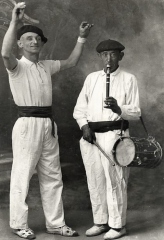 1933 txistulari Antonio Artocha 1933 txistulari Antonio Artocha
dancer Pedro Trinidad |
|
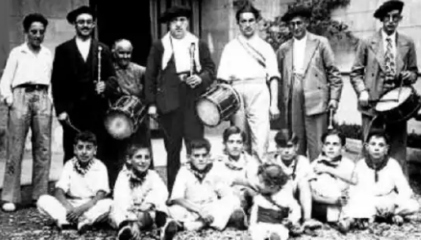 1930's Tafalla 1930's Tafalla |
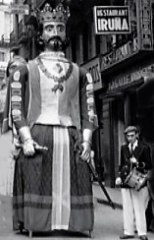
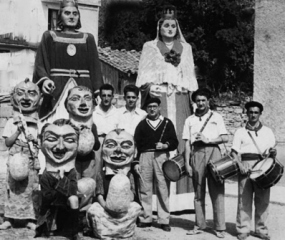 1955 festival with giants and big heads 1955 festival with giants and big heads, Huarte |
|
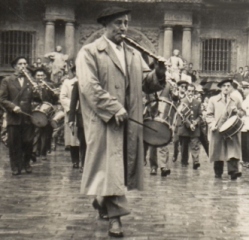 1958 festival of San Fermín, Pamplona 1958 festival of San Fermín, Pamplona |
|
|
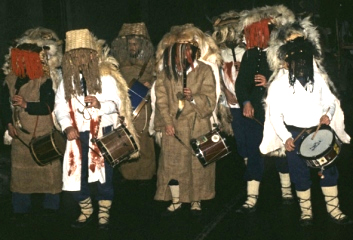 1983 carnival, Alsasua 1983 carnival, Alsasua |
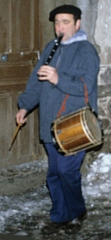 1983 Shrove Tuesday, Lanz 1983 Shrove Tuesday, Lanz |
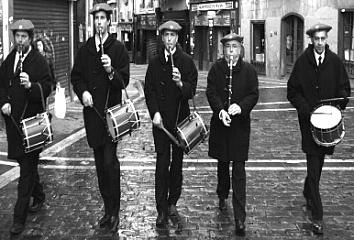 Pamplona town band Pamplona town band |
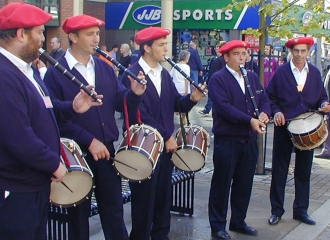 2001 Banda de Txistularis Municipal de Pamplona 2001 Banda de Txistularis Municipal de Pamplona
at the
annual
Symposium of The Taborers Society |
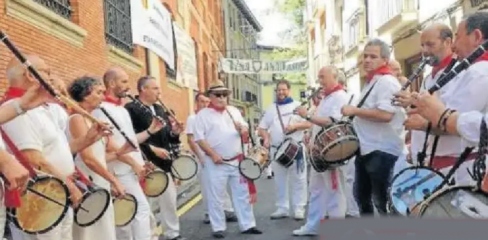 2021 Ortzadar Society 40 years celebration, Pamplona 2021 Ortzadar Society 40 years celebration, Pamplona |
 1980 instruments from Baztan 1980 instruments from Baztan |
|
tabors from three regions compared: Catalonia, Ibiza and Navarra 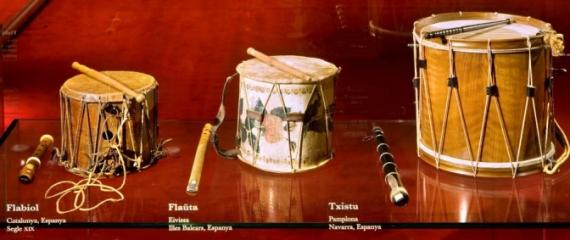 Music Museum of Barcelona [image no longer on their website] Music Museum of Barcelona [image no longer on their website] |
| |
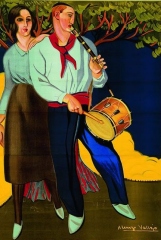
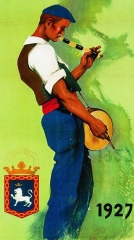
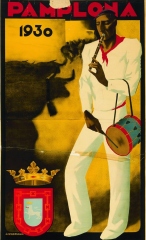
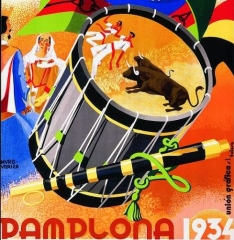
Navarre local tourist posters |
|
|
|
| |
|
La Rioja |
1615 emblem book illustrations: Bacchus 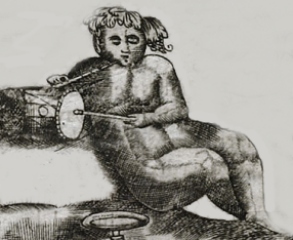 |
|
|
'Master declaration on the emblems of Andres Alciato'; Najera, La Rioja |
|
| |
|
Valencia |
|
|
|
 1482-1548 centaus stone carving outside 1482-1548 centaus stone carving outside
The Silk Exchange' |
 16th century 16th century
front wall, Xàtiva antic hospital |
|
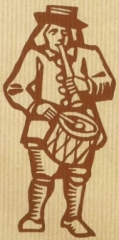 2011 from a poster advertising 2011 from a poster advertising
a medieval market, Dénia |
 2014 La Todolella 2014 La Todolella |
|
|
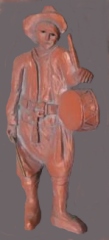 |
clay plaque [image no longer online] |
| |
1490 extracts from the story 'Tiant the White' [translated from Spanish]:
The most elaborate processions described are those …in which the participants could be of the most varied kinds—
"After the miners came many kinds of troupes. After them came all the clergy [...] After them came all the women
of the Third Rule, all singing the Magnificent After them came all the public women and those who lived in love
And they walked dancing with tambourinos"
“…on some occasions all these instruments appear inside the temple, the usual destination of most of the processions —
“E Tirant [...] enters through the church of Sant Jordi with many minstres, trumpets and tambourinos”
Tirant rode … with great triumph, with a multitude of drums, trumpets, cymbals and tambourinos, entered the city,
where they were done great honour” "And when the murder was done, they returned to the palace in the same order,
with multitude of trumpets, clarones and rings, tambourinos and ceramites and other diverse instruments
in a boat —“we go to the shore with many boats, all covered with silk cloth, [...] and we go by the river consoling
and fishing and taking pleasure with many trumpets, clarones and tambourinos”
After the betrothal, a very grand feast began in the palace and throughout the city, [...] the music, … countless trumpets,
indigos, clarinets, tambourinos, xeremias, bagpipes and drums [...], the noise made in the palace was so great [...]
that it seemed as if the world were collapsing." |
|
















#/media/Archivo%3ALuna_(Zaragoza)_Santiago_2_0_2_1_Fachada_Sur_Canecillos_pandereta.png)



_-_LA2403_-_Hispanic_Society_of_America.jpg)
