A short History of the Pipe and Tabor in Scotland
by Pete
"He saw her dance . the Spaines pavie to a whissill tabourier" 1 1599
It appears that the term 'tabor' was used as the name for the player from the 1400's to 1600's. However,
there are over 25 different spellings for the word tabor in the Scottish language. 2Many of the pipe and tabor players who entertained at court and in grand houses are recorded in Scottish
Royal Treasury Accounts:"Whissillis for tabernaris, the dozen xx s." were purchased in 1610 3 ;
the payment of £42.0d was made to Guillam, taubronar, to buy himself "quissillis" in1506.
[Whissillis, quissillis 4 may be pipes or whistles]Therefore there is a possibility that the earliest mention of a pipe and tabor player in Scotland is
Stephano Taburner 5 in 1330.Taborers were regular court entertainers in the time of James IV, King of Scotland, between 1488 and 1513.
He encouraged musicians from Europe as well as local pipe and taborers to play at Court and during his visits around Scotland.
'1489: 4 May: 28.0d to Pringill, to mend his tabor.
1492: 6 March, at Stirling: gift of 27.0d to the taborer that played to the king, and the rope-dancer with him'.
28th March(Easter) 1497 36.0d was paid to 'William and Pais, taborers, and a rope-dancer with them.'[Rope-dancing was a popular entertainment, which involved dancing on a slack-rope.]
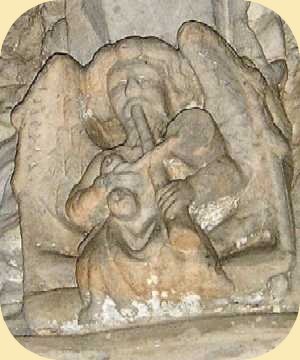
A taubronar angel sculpture at Rosslyn Chapel, Midlothian, could be one of the many players whose
names appear regularly in the Royal Treasurers Accounts. This sculpture is one of a group of musicians
which were probably carved around 1470/80. There is a drawing of it in 1839 (by Dalyell); the wrist
bells were missing and must have been 'restored' when all the carvings were redone in 1861. This
photograph was taken in the late 20th century.
1501 6s. 8d. paid from the royal coffers to " a strange taborer."
From ‘The Story of the Bagpipe’ Page 82 The Music Story Series Edited by FREDERICK J. CROWEST.
In 1502 a string of payments was made to taborers some of whom were regularly given payments:
"14.0d each to Adam Boyd, Ansle, William, John Portuous and a taborer of Leith, taborers.
8 February: gift of 42.0d to the men that brought in the Morris dance, and to their minstrels.
20 July: 42.0d to Ansle, taborer, to buy himself a new tabor. "
The 'Moorish taborer' was one of the most renowned of the Court taborers who appers to travel with the King:
"1503 14 June: 14.0d to the Moorish taborer.
3 July, in Linlithgow: 14.0d to the Moorish taborer, to hire a horse to go to Stirling,
and to pay for his lodgings in Linlithgow.
Payment of £4.4.0d for a horse for the Moorish taborer, bought from Pete John, trumpeter.
5s.10d to the Moorish taborer, for his lodgings and expenses in Falkland."
These court taborers were obviously highly esteemed as considerable sums were spent on their livery, for example:
"be the Kingis command, to the Moryen taubronar
to pay for paynting of his taubroun, . xxviij s."
[to the Moorish taubronar 28 shillings for painting his tabor]
Regular court pipe and tabor players had other duties including that of dancing master:
"1504 c3-7 February: [ Shrove Tuesday ]
payment of £13.2.10d for the coats and hose of twelve dancers
in an entertainment devised by the Moorish taborer against "Fasteringis Evin"
1506 "Item [the secund day of March], to Guilliem, taubronar,
lerand the Kingis dochtir to dans, be the Kingis command, ...... xviij s."
[ teaching the king's daughter to dance 18 shillings ]"Item, to Guilliam, taubronar, lerand Lady Mergret in the Castell to dans, "
"Item To Guilliam, taubronar, for making of ane dans the tyme of the prince's birth
[ for choreographing a dance to celebrate the prince's birth ]
In addition to court and the local taborers brought in to play for special occasions there appear to have
been pipe and tabor players on board ships for royal visits:
1502 28 May: 14.0d to the taborers of the "Jacat".
[Jacat is the name of a ship; James IV was inspecting the fleet in the Firth of Forth]1503 9 May: 14.0d to a taborer and a fiddler in Leith;
6.0d to the taborer of Robert Berton, in the ship;
c.30-31 May, in Leith: 7.0d to Quhynbore, the taborer there.
All these court musicians lost their posts (those who still had their lives) after the Battle of Flodden in 1513
which ended in victory for the English.
But local taborers were still around in the 16th century. Some are recorded as committing crimes: there was
a conviction
of Guilliam Tawbronare for the killing of Patric Harpare in 1506, in Edinburgh. Sometimes
the pipe and tabor was used
in church: in 1575 a complaint was made to the General Assembly that
the people of Dumfries had:
"brought their own reader with tabroun and whistle and caused him read the prayers" 6
The term for a drum changed from tabor to 'swasche' during the 16th century
(1523 is the earliest I have so far found).
At first it was called the 'Swasche tabroun' and later just 'swasche'. This word derives from the military drum
introduced by Swiss mercenary soldiers across Europe. So payments were made in 1560:
"For playing vpone the swesche and quhissill befoir the nychbouris of this burgh twa dayis quhen thai wer in armorie"
[ For playing on the Swiss drum and whistle in front of the neighbours of this burgh for two days when they were in armour , that is, at the burgh muster, known in Scotland as 'weaponschaw']. 7
References to pipe and tabor players diminish during the 17th century after England and Scotland were united under
one King (English James I) and public entertainments were banned by the Puritans. Whenever they are mentioned
they are associated with alleged poor behaviour.
In 1610 Richert Skowgall "thair commoun pyper and swascher"
was too playful and was indicted and accused of :
'drinkand and playand and gestand . all that nycht in the Tolbooth and upon the wall heid thairof"
[ drinking and playing and jesting all that night in the Tolbooth (prison) and on the top of the wall ]. 8
Pipe and swasch in Haddington in 1610; a local lawyer is being held in the Tolbooth and he invites his friends
in for a party which leads to them:
"drinkand and playand and gestand in Richert Skowgall thair common pyper and swascher with ye swasch and his pype as also Johne Grahame pyper"
John Dalyell in 'Musical Memoirs of Scotland', 1849, cites another two instances:
in 1624 'Thomas Smyth, 'whisler' was threatened with banishment for drinking and playing during divine service.
In 1688 the minister of Dalkeith was maliciously accused of 'dancing about a bonfire . with pipe and drum'
In the late 18th century the instrument survived, or at least was revived, in Banff in the north-east of Scotland.
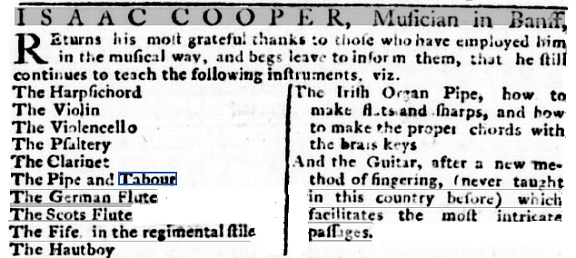
This echos the popularity of the instrument in England and in France. Isaac Cooper advertised on 31st March 1783:
"Isaac Cooper, musician in Banff, returns his most grateful thanks to those who have employed him in the musical way, and begs leave to inform them that he still continues to teach the following instruments, harpsichord, violin, violincello, clarinet, psaltery, pipe and taberer ."
One has to wonder how many pupils he had. Sir Walter Scott (1771 - 1832) was certainly familiar with the pipe
and tabor as he mentions it in five books. Possibly he was not a fan as in 'Redgauntlet' (1824), when the blind fiddler
Willie, arrived late to play at a dance, he hears the sound of music:
"--Stay--hark--it 's no a fiddle neither--it's the pipe and tabor bastard, Simon of Sowport, frae the Nicol Forest; but I'll pipe and tabor him!--
Let me hae ance my left hand on his cravat, and ye shall see what my right will do."
Notes
1The Spanish Pavan 1599
.Ane Spryng of the Spanish Pavan is one of the tunes listed in the lost Straloch lute MS of c.1627, and it is also
in the Skene mandora MS, c.1630 {National Library of Scotland, NLS Adv. 5.2.15), where it is titled 'I Love
My Love for love again'. Spanish keyboard variation exist dating from 1546. It appears as The Spanishe Pavane'
in William Ballet's lute book, c. 1595, as well as at least 20 other sources [see Julia Craig-McFeely's thesis at http://www.ramesescats.co.uk/thesis/]. This was clearly a popular tune across Europe for 100 years. Two
different tunes with this title survive; the most familiar is in the Fitzwilliam Virginal Book II (John Bull,
The Spanyshe Paven , c. 1600); the other is in Arbeau's Orchesographieof 1589
According to Maria Dolmetsch in Dances of Spain and Italy1400-1600 , it 'goes at a lively pace, unlike
the stately solemn processional pavan'.
Memoirs of the Maxwells of Pollok. Fraser, Sir William; 2 vols., Edinburgh, 1863
2The Dictionary of the Scots Language lists at least 25 different spellings
3 B' Whissillis for tabernaris, the dozen xx s.;' The Book of Customs and Valuation of Merchandises in Scotland,
1612. In Ledger of Andrew Halyburton, Conservator of the Privileges of the Scotch Nation in the Netherlands,
1492-1503. Series of Chronicles and Memorials (General Register House) H.M. General Register House, Edinburgh,
1867. pp 332. MS NAS E76/3. pp 279-341. MS NAS E76/3. (DOST Lib.)
4Accounts of the Lord High Treasurer of Scotland (Compota thesaurariorum Regum Scotorum) Balfour Paul,
Sir James, Edinburgh, Vol II (1877). Vol III, 1506/7 .
5The Exchequer Rolls of Scotland, 1264-1600
6Musical Memoirs of Scotland , Dalyell, John, Edinburgh, 1849
7Extracts from the Records of the Burgh of Edinburgh, 1403-1589. Marwick, J.D. (ed.); 4 vols., BRS,
Edinburgh, 1869-82III 63
7 Haddington Burgh Records, cited in "Secular Music in the Burgh of Haddington 1530-1640" McGavin, John,
in Music and Musicians in renaissance Cities and Towns , Kisby, F, 2001
The Glen Collection of Scottish Dance Music , vol. 1,
For examples of quisselles: dictionary of the older Scottish Tongue
http://www.celtscot.ed.ac.uk/dost/index.html
? 1387 " And they Scotlond the douzter of Irlond use harpe, tymbre, and tabour, Dictionary of Middle English Musical Terms |
||||||||||
| May 1504 Robert Barton was a shipowner who supplied timber for the king's shipbuilding. He had a taubronar on his ship [ |
||||||||||
| Information on the African taborer, More, here | ||||||||||
1505/06 Accounts of the Lord High Treasurer of Scotland: In 1506 two more taborers also received regular payments - Adam Boyd, taubronar; Quhynbore, taubronar. During these two years other taborers were given one-off payments: 'Accounts of the Lord High Treasurer of Scotland = Compota thesaurariorum Regum Scotorum' |
||||||||||
1516 ‘Renaissance Culture at the Court of James V, 1528-1542’ by Andrea Thomas, 1997, page 46 |
||||||||||
1548 poem 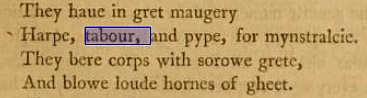 ‘The Complaynt of Scotland : written in 1548 ; with a preliminary dissertation, ‘The Complaynt of Scotland : written in 1548 ; with a preliminary dissertation, and glossary’ by Leyden, John ed, 1801 |
||||||||||
| 1596 “The commoun corruptiouns of all Estates within this realme” “And great number of idle persons without lawfull calling, as pypers, fidlers, sangsters, sorners, pleasants, strang beggers, living in harlotrie, and having thair children unbaptizit…” Acts and Proceedings of the General Assemblies of the Kirk of Scotland, 1560-1618 |
||||||||||
25 July 1612 Records of the Burgh of Glasgow Vol. 1, 1573-1642. |
||||||||||
1617 “…The taborer and whistler of James, earl of Abercorn, attended the youths at the morris dance Accounts of the Masters of Works for Building and Repairing Royal Palaces and Castles. Volume 11 :1616-1649 . |
||||||||||
1665-1666 Edinburgh Accounts : ‘FOR PLAYING UPON THE SWESCHE AND QHISSILL PART THREE THE ALMANY QUHISSIL’ by Pete Stewart, 2020 |
||||||||||
1754 Advertisement in the Caledonian Mercury: |
||||||||||
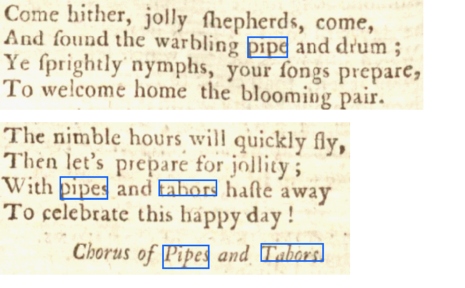
1772 Epithalamium on the Marriage of the Earl of Strathmore |
||||||||||
1781 essay
‘0f the Effects of Music on the Character of Nations’ by the Rev, Mr Sherlock. The Weekly Magazine, or Edinburgh Amusement 1781-09-13: Vol 53 |
||||||||||
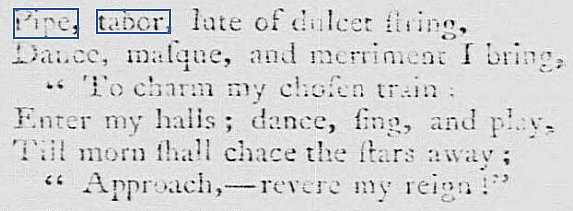
1789 poem “The pipe and tabor, violin and harp, The Scots Magazine 1789-05: Vol 51 |
1793 poem “…Or fore or aft, to dancing quick repair; The Bee; or Literary Weekly Intelligencer, consisting of original |
|||||||||
1799 medical essay  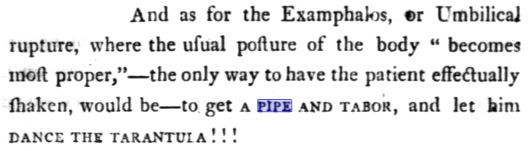 ‘Number second, being remarks on the first volume of Mr. Benjamin Bell's system of surgery. ‘Number second, being remarks on the first volume of Mr. Benjamin Bell's system of surgery. by Jonathan Dawplucker, Esq.’ 1799' by Barclay, John, M.D., of Edinburgh. |
||||||||||
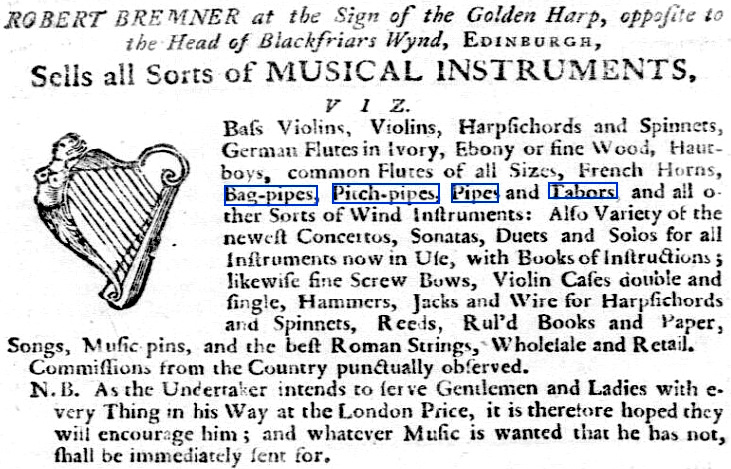
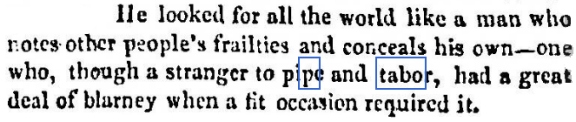
1804 seller of all sorts of goods: |
||||||||||
poem by John Galt 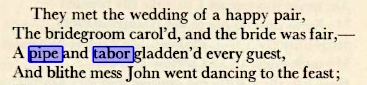 |
||||||||||
1807 story
‘The Downhill! of Life - a Vision’ Walker's Hibernian Magazine, Or, Compendium of Entertaining Knowledge 1807-05 |
||||||||||
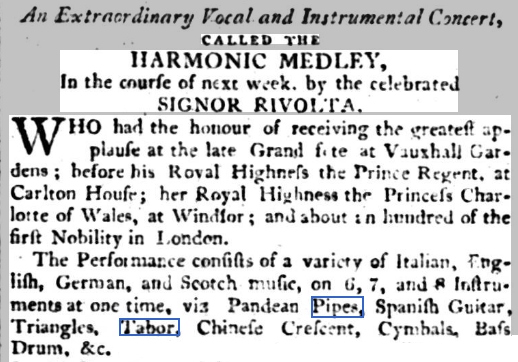
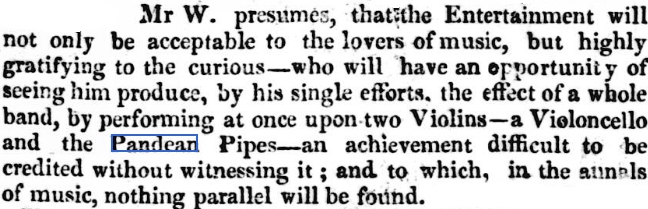
1814 a one-person band, Signor Rivolta, tours Scotland |
||||||||||
| 1817
story 'FRAGMENT OF A LITERARY ROMANCE.
'
“…Others were employed in dancing ; but the figure was unlike any thing I had ever seen before, Blackwood's Edinburgh Magazine 1817-08: Vol 1 Iss 5 |
||||||||||
1822 story ‘The Levee and Drawing-Room’ Blackwood's Edinburgh Magazine vol XII |
||||||||||
1825 Bible commentry  ‘Illustrations of the holy scriptures. 3. From the customs and manners of ancient and modern nations’ by George Paxton ‘Illustrations of the holy scriptures. 3. From the customs and manners of ancient and modern nations’ by George Paxton |
||||||||||
1828 a one-person-band performs in Inverness |
||||||||||
| We Love the Shrill Trumpet - by Sir Walter Scott
“…If there 's mirth in our house, 't is our neighbor that shares it— | ||||||||||
1834 poem
‘A Legend of St Anthony’  'The literary life, and miscellanies, of John Galt : in three volumes' ; 2 by Galt, John 'The literary life, and miscellanies, of John Galt : in three volumes' ; 2 by Galt, John |
||||||||||
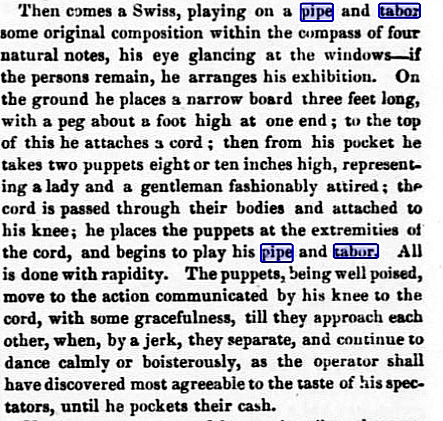
1834 marionettes: 'Street Exhibitions in London' |
||||||||||
1841 poem 'DRUMNAGARROW'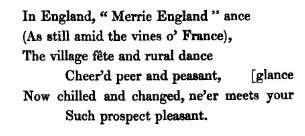 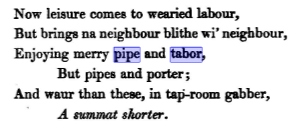 'Poems and Songs'
by
John Imlah 'Poems and Songs'
by
John Imlah |
1841 poem 'Fragments': 'Poems and Songs' by John Imlah, page 77 |
|||||||||
1844 newspaper political essay
‘The State of Parties’ |
||||||||||
1848 newspaper political comment |
||||||||||
|
||||||||||








(added to and edited by Frances)
top of page