|
|
check this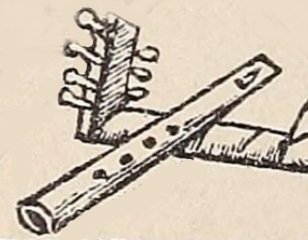 15th century 'L'art de l'imprimerie pendant la renaissance italienne' 15th century 'L'art de l'imprimerie pendant la renaissance italienne' |
|
1474 treatise on education which achieved considerable popularity
and was printed in thirty Italian editions
before
the year 1530:
“music made by singing or striking [strings] is quite seemly;
while blowing [playing wind instruments] is less suitable to gentlemen.”
''De ingenuis moribus ac liberalibus studiis'
(On the Manners of a Gentleman and Liberal Studies), Pier Paolo Vergeri |
1478 treatise discussing which instruments
are ‘approved’ and ‘disapproved’ ‘trumpeters,
pipers and drum players”
come into the latter category
…as infamous, based on Aristotle’s condemnation
of wind instruments”
‘Tractatus de Ludo’ by Stefano Costa |
|
1501 translation of a ninth century text in which the Persian
astrologer Abu Bakr al-Hassan ibn al-Khasib
suggested
how the stars might influence the development
of a child’s
character and ultimate fate:
Chapter 100 ‘On the birth of jongleurs [Ioculatores] “When Venus is with Mercury in her house, and in the angles:
the native will be a mime or jongleur such as play instruments with the hand and tongue…."
first printed edition of the Latin translation of the Book of Births, (Venice: Giovanni Battista Sessa) 'Liber Nativitatum' 850-875 |
|
|
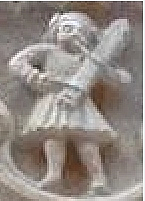
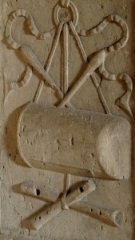 1505 bas relief, Vicenza 1505 bas relief, Vicenza |
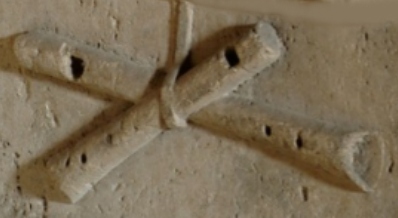 close-up of pipes close-up of pipes |
|
 1510 plate rim, made in Faenza, Ravenna, Emilia-Romagna 1510 plate rim, made in Faenza, Ravenna, Emilia-Romagna
|
|
|
 door panel door panel |
 |
|
|
|
|
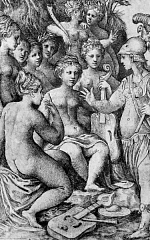
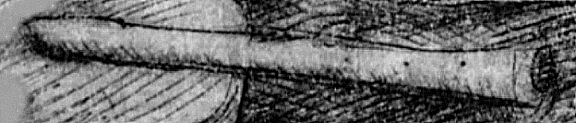 16th century 'Minerva and the Muses'; the pipe is on the ground in the foreground of the image 16th century 'Minerva and the Muses'; the pipe is on the ground in the foreground of the image |
|
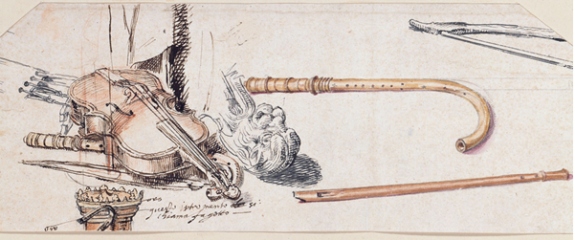 1515 drawing by Giovanni da Udine 1515 drawing by Giovanni da Udine |
|
 1515 close-up of pipe 1515 close-up of pipe |
|
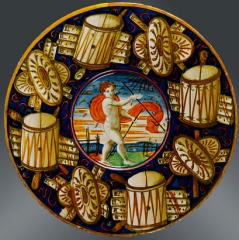 1537 tin-glazed earthenware, Gubbio, Perugia 1537 tin-glazed earthenware, Gubbio, Perugia. |
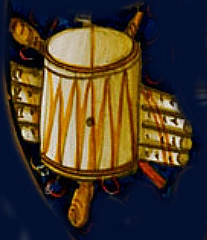 close-up of one of the motifs around the rim close-up of one of the motifs around the rim |
|
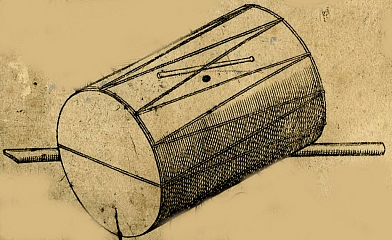 1553 ' Military Trophies Plate 12' print 1553 ' Military Trophies Plate 12' print
|
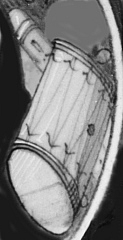 1555 majolica plate, motif from rim 1555 majolica plate, motif from rim |
|
| |
|
|
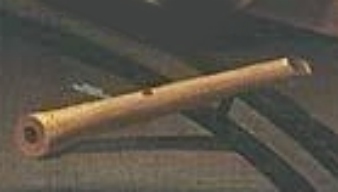 close-up of pipe close-up of pipe |
|
1825 discovery of old instruments  La Belle Assemblee 1825 number 231 page 183 La Belle Assemblee 1825 number 231 page 183 |
|
|
|
|
|
|
|
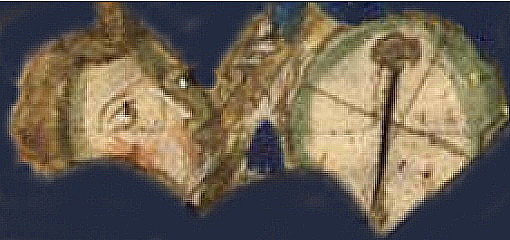 13th century Rome; close-up of taborer (in back row) 13th century Rome; close-up of taborer (in back row) |
|
|
|
|
| |
14th century |
|
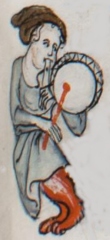 1319 Rome 277r 1319 Rome 277r |
|
|
 1360-1370 part of an angel band 1360-1370 part of an angel band
fresco, Siena |
|
 part of loud band in boat part of loud band in boat |
|
|
late 13th / early 14th century poem:
"...You heard the sound of many sweet dances
with guitars and numberless carribi;
and trumpets and reed flutes all in harmony,
and well chosen German cymbals;
Cannoni and mezzi cannoni being played freely,
pipes and well tuned drums..."
'L’intelligenza', an allegorical poem by Lippo Pasci de’ Bardi, Florence |
"The town band of Pisa in 1324 had one shawmist, one nakerer
and two pairs of trumpeters. For a larger band, a bagpiper
or a pipe-and-taborer, being readily available, might be added.
These were military bands in the full modern sense,
performing
at state functions, cavalcades, tournaments and in battle."
‘Woodwind Instruments and their History” by Anthony Baines, 1956 |
|
|
|
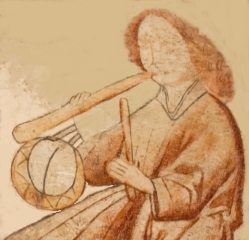 1420 fresco, Vignola Stronghold, Modena 1420 fresco, Vignola Stronghold, Modena |
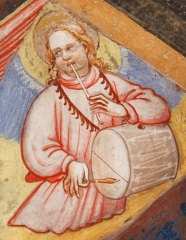 1420 angel fresco, Vignola Stronghold Modena 1420 angel fresco, Vignola Stronghold Modena |
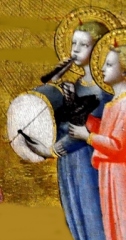 1424 alterpiece 1424 alterpiece |
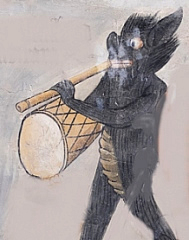 15th century demon fresco 15th century demon fresco
Church of San Fiorenzo,
Bastia Mondovi Piedmont
|
|
|
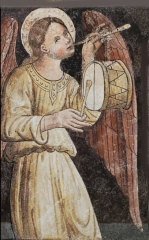 1450-1500 angel, Treviso 1450-1500 angel, Treviso |
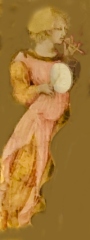 1460 angel, Siena 1460 angel, Siena |
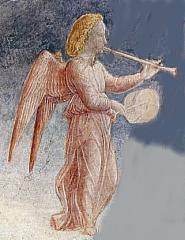 1462-1468 fresco, part of an angel band 1462-1468 fresco, part of an angel band
Portinari Chapel, Milan |
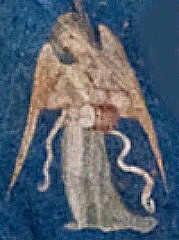 1473 fresco, angel, Milan 1473 fresco, angel, Milan |
|
|
|
|
|
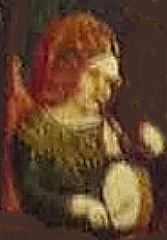 1487 part of angel band 1487 part of angel band
Vicolo San Silvestro, Verona |
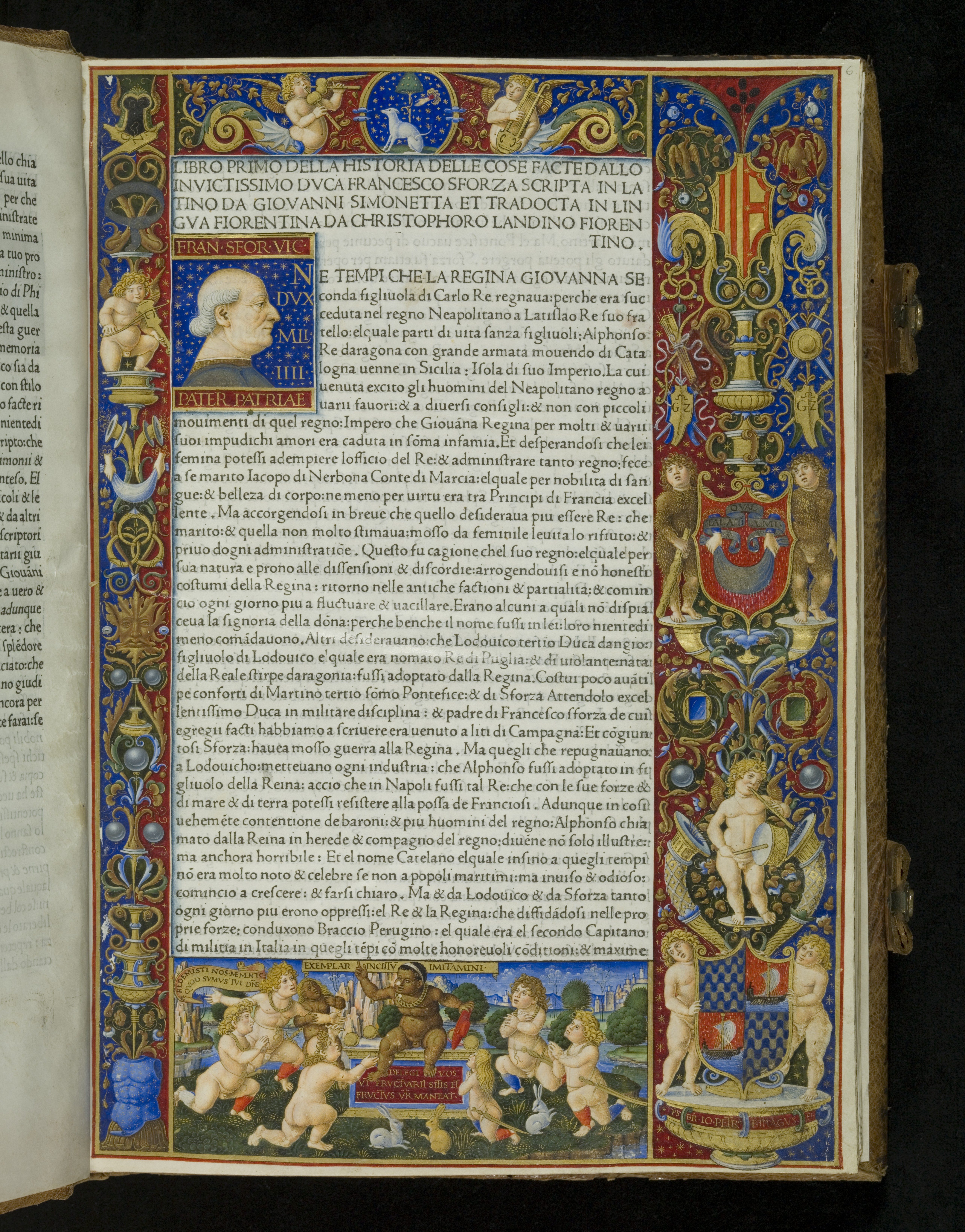
 1490 printed book 1490 printed book
illustration, Milan |
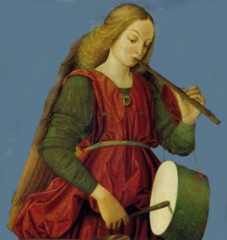 1493 in angel band, painting, Urbino 1493 in angel band, painting, Urbino |
|
|
|
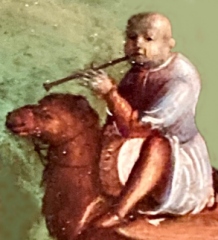 1499 painting 1499 painting |
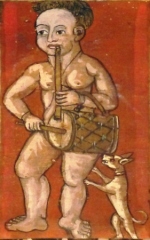 near Turin, details unknown near Turin, details unknown |
|
|
 1473 painting, loud angel band, Pisa 1473 painting, loud angel band, Pisa |
|
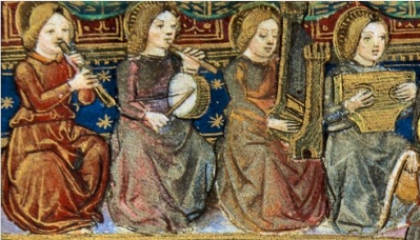 1476 soft band, Turin 1476 soft band, Turin |
|
ca 1410 fresco
“Besides harp, angels play four trumpets, nakers, pipe and tabor, fiddle, double recorder, portative organ,
tambourine, triangle, lute, shawm (recorder) and cymbals”
'Assumption of the Virgin' by Gaultieri di Giovanni da Pisa. Siena: Chiesa Santa Maria del Carmine |
|
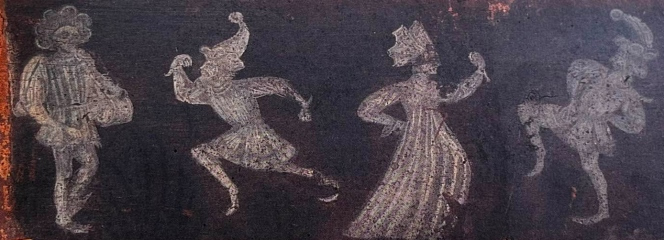
15th century northern Italy:
description of a box lid made of wood and bone:
“eight figures in two rows are depicted on the lid of a box, each with a double frame. One of them (bottom row, left)
plays a snare drum and blows a one-handed flute. The other seven figures are dancing" |
|
1450 angel player, Lombardy
"Carried by angels, Mary ascends to heaven and is crowned
by Jesus Christ. He is surrounded on the right
and left by choirs
of angels singing from scrolls. On the far left two angels play music
with one-handed flute
and drum, rebec..." |
|
pipe and tabor players retained in upper class households check link ‘Renaissance Women as Patrons of Music’ by William Prizer ‘Renaissance Women as Patrons of Music’ by William Prizer |
|
find link
1469 Milan Galeazzo Maria Sforza, a patron of music, spent 5,768 lire on secular musicians—
seventeen ducal
trumpeters, five pifferi, a lutenist, a viola player, and a pipe-and-tabor player (tamborino) |
|
| |
15th century Italian military players |
|
|
|
1451-1500 Naples, description of armies:
"Two army trains are marching to the right and left around a tent camp.
They are each led by a drummer
with a one-hand wind instrument." |
 1458 army taborer 1458 army taborer
manuscript
illustration |
|
|
|
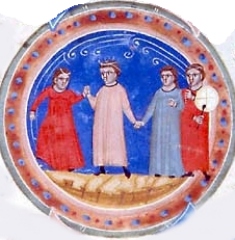 1324-1328 zodiac sign: Gemini; playing for dancing 1324-1328 zodiac sign: Gemini; playing for dancing
Bologna |
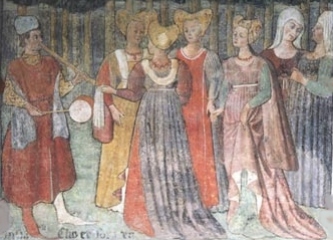 15th century dancing at court Find Link 15th century dancing at court Find Link |
|
|
 1457 manuscript, jester playing for dancing, Mishneh Torah 1457 manuscript, jester playing for dancing, Mishneh Torah |
|
|
15th century dance treatise Check Link  "Artistic" Theory of Dance in Fifteenth-Century Italy’ by Barbara Sparti, page 184 "Artistic" Theory of Dance in Fifteenth-Century Italy’ by Barbara Sparti, page 184 |
|
15th century dance book:
“…In a Ballo it is clear that the same tune played by a pipe and tabor or by a lute
or by a trio of reed-instruments cannot have the same arrangement…
In the Balli of French origin found in the Italian treatises or whose music was taken
from the French repertory
to create an Italian choreography it has been particularly suitable
the use of the one-hand
flute together with
the tabor (pipe and tabor), not only by accident"
‘Mesura et arte del Danzare: Italian Balli of the XV Century’ |
|
Dance treatise: Check Link
“Songs-and special singers were occasionally used to accompany the dancing and several references are made
to tamburini [pipe and tabor-players] who helped 'to keep the measure' “.
Tamburini could also mean drums
‘De pratica seu arte tripudii = On the practice or art of dancing’ by Guglielmo, Ebreo da Pesaro |
|
|
1510 music is considered to be base and liable to corrupt: it is not a fitting recreation for adolescents:
“But to lead dances, to play [instruments], …is for pimps and for the plebeians: for both wickedness and laziness
are wont to arise from music, especially at this time”
‘De generosa liberorum educatione (On the noble education of children).’ by Jacopo di Porcia |
|
1600 freize on a spinet made in Venice, playing for dancing:
"musicians and dancing putti above the keyboard, from left to right: a putto with one-handed flute and drum..." |
|
check link
Description of an allegorical representation of the world, and the means of escape from its perils and follies....
In the centre is a painter at his easel, a company of people dance to a tabret and pipe. source
'The book of Sancto Giovanni Climaco of the escape of the world and of the Sancta Scala begins.' Transactions of Bibliographical Society, London, 1892 |
|
Lucrezia Borgia (1480-1519) in Ferrara and Isabella d'Este (1474-1539) in Mantua were patrons who competed
against each other and formed a rivalry in which they “were never friendly with one another.” Both women
expanded
elements of music such as: “frottolists, singers, string players, and a pipe-and-tabor player!”
‘Renaissance Music’ by Puneet Sharma, 2010 |
|
check link
1487 Lucretia d’Este’s wedding festivities in Bologna
"...among the grandiose celebrations was a remarkable rappresentazione: a fable of love, chastity, and marriage.
The allegory-spectacle included vocal and instrumental music, dramatic-poetic text (spoken and sung), scenic effects
(moveable stage machinery), costumes, mime, and a great deal of dance.
... a prelude, which featured the extraordinary
dexterity of a six-year-old Tuscan girl dancing both alone and with a male partner (her teacher?) to the accompaniment
of pipe and tabor |
|
check link
1490 wedding festivities for Isabella d‟Este in Mantua
During a performance of a play by the ancient Roman playwright, Plautus,there were three intermezzi:
the first was a dance done with torches; the second was sung. The third, a moresca in mime and dance, featured
a group of “rustics” who, with hoes, spades, rakes, and winnowing fans, alternately “worked the land” and “fought
with swords,” always keeping in time to the pipe and tabor music and cuffing each other for fun at their exit" |
|
check to find link
On 6 January 1502, Lucretia Borgia left Rome for Ferrara ...
During the first ball, the ambassador from Parma
reported that Lucretia
“danced many dances, in Roman and Spanish fashion, to the music of her pipe and tabor players.”
Lucretia Borgia-Este’s Wedding Festivities: Rome and Ferrara, 1500–1501 |
|
1502 an entertainment for Lucrezia Borgia
“…In the evening they all again went to hear the comedy which was the Asinaria of Plautus, and which occupied
five hours….After the first act was represented a moresca commenced, in which fourteen men were dressed as satyrs
— one performer having on his shoulder an ass’s head covered with plates of silver, playing a pipe and tabor.
The moresca began by the player of the pipe and tabor first appearing on the stage….”
‘Lucrezia Borgia, duchess of Ferrara, a biography’
by William Gilbert, 1869 |
|
1506 dancing master for Lucrezia Borgia 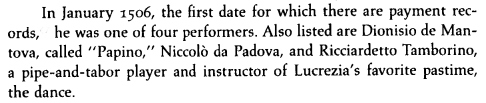 ‘Renaissance Women as Patrons of Music’ by William Prizer ‘Renaissance Women as Patrons of Music’ by William Prizer |
|
|
|
|
|
 1504 in an angel band, Florence 1504 in an angel band, Florence
|
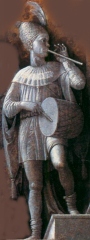 1506 part of a classical-style 1506 part of a classical-style
painted frieze |
 16th century birth tray back, Florence 16th century birth tray back, Florence |
|
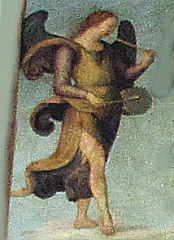 1506 angel, altarpiece Naples Cathedral 1506 angel, altarpiece Naples Cathedral |
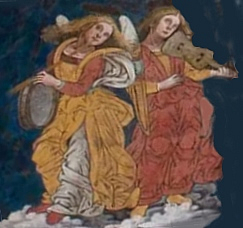 1507 angel musicians, Cori, Lazio 1507 angel musicians, Cori, Lazio |
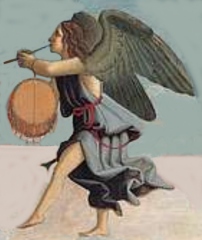 1516 angel, painting 1516 angel, painting |
|
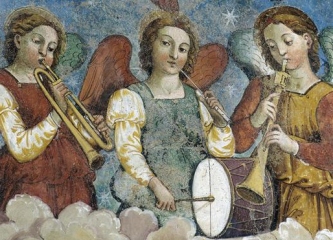 1520 loud band of angels, Pomarance, Tuscany 1520 loud band of angels, Pomarance, Tuscany |
 modern copy notelet modern copy notelet |
|
|
|
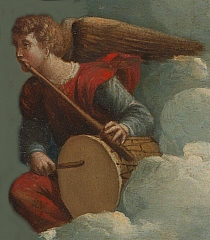 1520-1530 angel, painting, Biblical subject 1520-1530 angel, painting, Biblical subject |
 1521 angels, Milan, Lombardy 1521 angels, Milan, Lombardy |
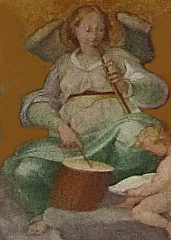 16th century fresco, angel 16th century fresco, angel
Basilica di Santa Pudenziana, Rome |
|
|
|
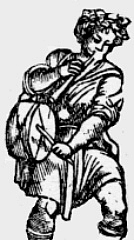 1533 woodcut, Ferarra 1533 woodcut, Ferarra |
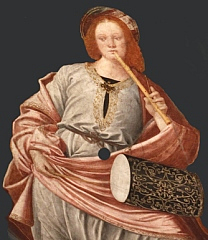 1536 'Concert of Angels, Saranno 1536 'Concert of Angels, Saranno |
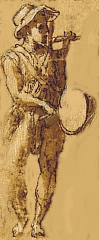
1547-1612 two Roman soldiers
with a taborer besieging a town |
 |
|
 |
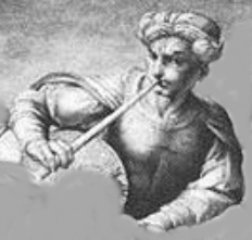 |
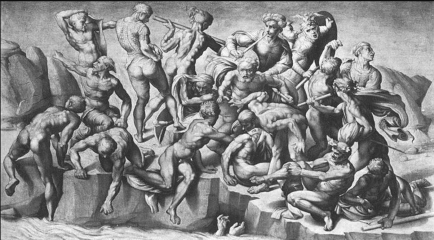
1542 fresco depicting the Battle of Cascina, Florence (which took place in 1364) |
|
|
|
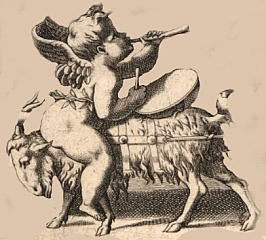 1545-1565 putto, engraving; copy of an earlier work 1545-1565 putto, engraving; copy of an earlier work |
 1555 painting inside a harpsichord, Salò on Lake Garda 1555 painting inside a harpsichord, Salò on Lake Garda
[Ed. possible; tried to check with museum] |
|
|
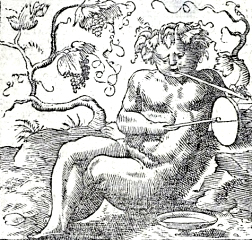 1560-1592 'Prudenza' Baccus from an emblem book 1560-1592 'Prudenza' Baccus from an emblem book |
|
|
|
1567 Margaret of Parma, (1522-86), was a notable patron of music and employed musicians in her household.
Her household accounts “ record New Year’s gifts, so it is difficult to know if the artists named are in her regular
employment or were simply hired for special occasions.… three records include payment to a trumpeter,
five Italian violin players, a fifer and drummer,
extra singers for the chapel, and two instrumentalists …”
‘THE MADRIGAL IN ROME: MUSIC IN THE PAPAL ORBIT, 1520-1555’ by Letitia Glozer, 2007 |
1569 Verona: an inventory lists several sets of flutes and recorders including a complete chest of twenty-two
recorders, two tabor-pipes, five crumhorns, and a curtal.
‘Instruments of the Middle ages and Renaissance’ by David Munrow, 1976 |
|
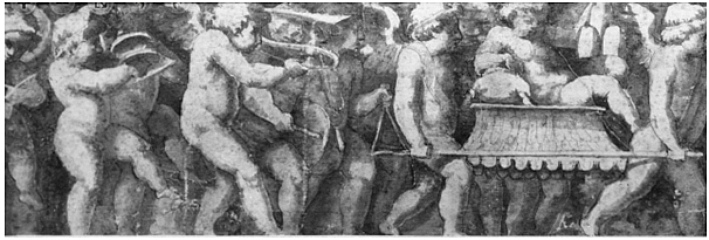 16th century classical-style procession 16th century classical-style procession putti taborer
(centre of image) putti taborer
(centre of image) ' reconstruction' |
1598 Italian and English dictionary:
Tamburrino, a little drum, a tabour, a timbrell, a drum-slade. Also a drūmer. Also a little trunke. Also a tabour and pipe.
Tamburiere, a drummer.
Tamburro, a drum, a timbrell, a tabour, a drumslade. Also a drummer.
‘A worlde of wordes, or Most copious, and exact dictionarie in Italian and English,’ collected by John Florio, London |
| |
17th century |
|
|
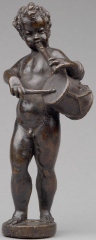 c.1600 statuette c.1600 statuette |
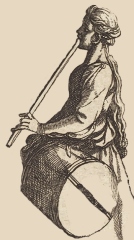 1613 Biblical image, women's band 1613 Biblical image, women's band |
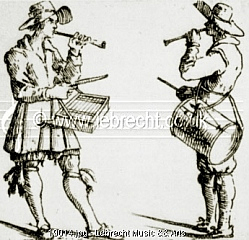 1615 Rome 1615 Rome |
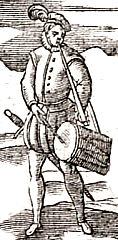 1621 emblem book, Padua 1621 emblem book, Padua |
|
1660 extracts from 'The History of Italy'  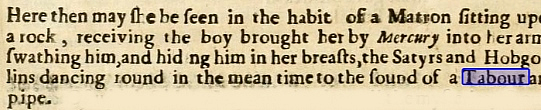 ‘The history of Italy from Rome to Naples - Italy in its original glory, ruine, and revival being an exact survey of the whole geography ‘The history of Italy from Rome to Naples - Italy in its original glory, ruine, and revival being an exact survey of the whole geography
and history of that famous country, with the adjacent islands of Sicily, Malta, &c. : and whatever is remarkable in Rome (the mistress of the world)
and all those towns and territories mentioned in ancient and modern authors / translated out of the originals for general satisfaction ‘
by Edmund Warcupp, Esquire: page 253/254 |
|
1666 'Varia Historia' from third century Rome was translated into English. The book is a miscellany of anecdotes
and biographical sketches, lists, pithy maxims, and descriptions of natural wonders and strange local customs:
" …As for Dionysius, he suffered the vicissitude of Fortune at Corinth, in extreme poverty, becoming
a Metragyrta, and begging Alms, beating a Tabour and playing on a Pipe till he died….”
‘Claudius Ãelianus, his various history’ tranhslated by Thomas Stanley, chapter VIII, ‘Of Dionysius his Incontinence’ page 175 |
|
Description of a caricature 'Scherzi di Fantasia':
"a fat figure on the left, four adorned men at her side, two of them
playing the lute
and one-handed flute
with a hand drum, on the right a thin figure with six ugly people in his wake."
caricature by Lodovico Ottavio Burnacini (1636 – 1707) |
|
|
|
|
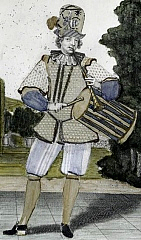 c.1699 at the Venice Carnival Opera c.1699 at the Venice Carnival Opera |
|
|
|
| |
|
18th century |
|
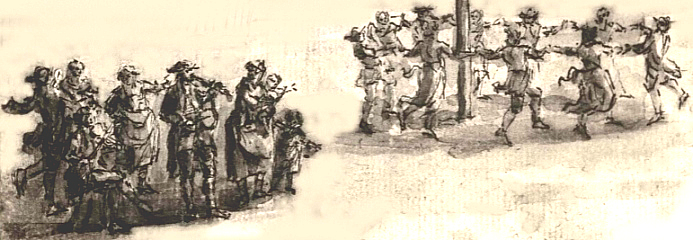 18th century in band playing for maypole dancing [search 'dance'] 18th century in band playing for maypole dancing [search 'dance'] |
|
|
|
|
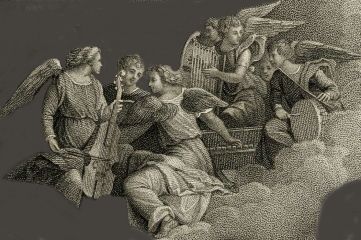 1816 angel band, engraving: copy of 1520-1535 painting above; 1816 angel band, engraving: copy of 1520-1535 painting above; |
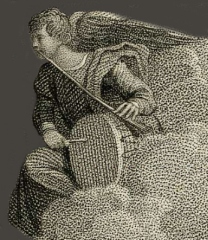 close-up of taborer close-up of taborer
|
|
1816 description of an engraving by Altobello:
"Four cupids playing on musical instruments
“…the fourth Cupid, on the right, wears a wreath, and plays
on the pipe and tabor.
The three last-mentioned
figures are naked. All the four have wings….”
‘An inquiry into the origin and early history of engraving, upon copper and in wood.’ by William Young Ottley |
|
|
19th century |
1822 'Letter from Italy' 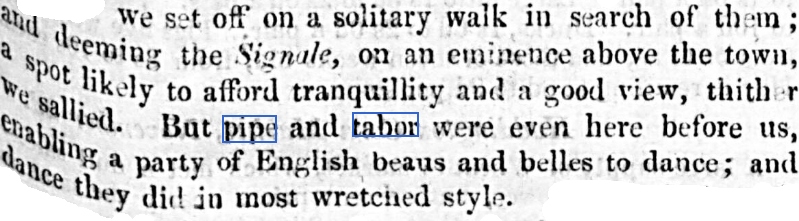 Glasgow Sentinel - Wednesday 06 November 1822 Glasgow Sentinel - Wednesday 06 November 1822 |
|
1862 newspaper report of robbers who danced all night 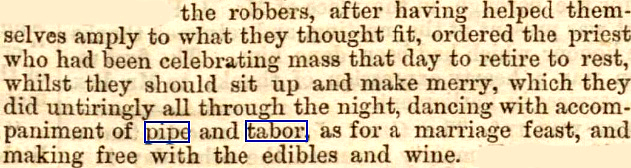 Hereford Times - Saturday 03 May 1862, England Hereford Times - Saturday 03 May 1862, England
|
|
1865 carnival in Venice, newspaper report by Whistlecraft (Byron) 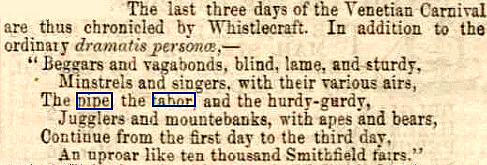 Bedfordshire Times and Independent - Tuesday 28 February 1865, England Bedfordshire Times and Independent - Tuesday 28 February 1865, England |
|
1866 Christmas music 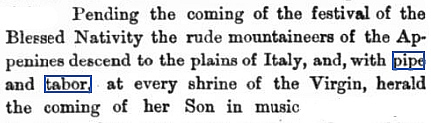 The Evening Freeman. - Monday 24 December 1866, Dublin, Republic of Ireland The Evening Freeman. - Monday 24 December 1866, Dublin, Republic of Ireland |
|
|
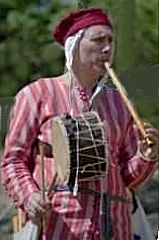 2017 in Borgoforte, Mantua, Lombardy 2017 in Borgoforte, Mantua, Lombardy |
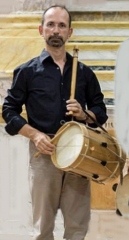 2020 Goffredo Degli Esposti, Umbria 2020 Goffredo Degli Esposti, Umbria |
|
| |
tarot cards, printed in Bologna |
|
|
|
|
Sardinia sulittu and tamburinu |
|
| |
|
|
|
|
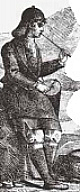 check to find link
1825 check to find link
1825 |
|
" I would like to point out the presence of the three-holed flute
and the tabor in Sardinia. It probably remained in use until the 1950s,
as evidenced by a film from that period ... in a series
of. instrumental performances"
"The tamburinu is small in size, and is made with two wooden planks
stacked and held together with nails. ... This combination is not native
to the island,
but was imported by the Iberian governors, which is why
it retains great similarities
with the combination found in the Balearic Islands.
Although it has now completely disappeared in Sardinia, it is known that it
was an important instrument to accompany dances and some liturgical acts."
The traditional method of making a drum here [video] |
|
|
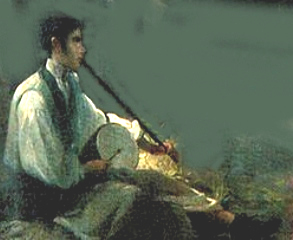
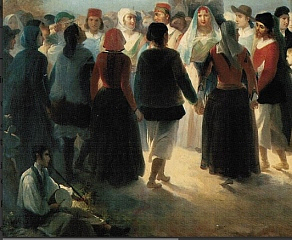 1861 painting, playing for dancing 1861 painting, playing for dancing |
 |
|
|
|
In many parts of Sardinia, especially
in the South, “Sa Tzerachia” was
in force; in practice a musician
was paid for a certain period
of time (usually a year) and this
person had to play for all special
occasions and for holidays
exclusively for the group that
hired him. |
|
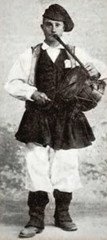 Pipaiolu and Tamburinu Pipaiolu and Tamburinu |
|
|
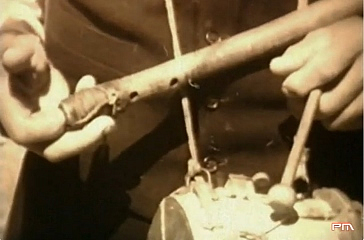 1954 instruments 1954 instruments |
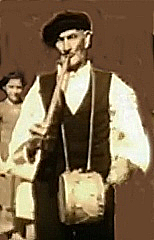
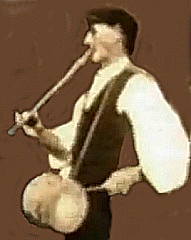 1954 player of Pipaiolu and Tamburinu 1954 player of Pipaiolu and Tamburinu |
 |
|
|
|
Sivli MOVE TO ABOVE SARDINIA |
|
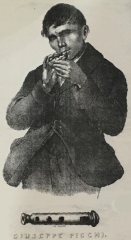
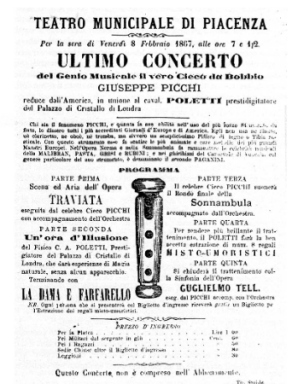
Around 1850-1860, in Italy and Europe and especially in England, a blind and skilled sivli player,
Giuseppe Picchi known as 'the blind man of Bobbio', played many concerts on the sivli.  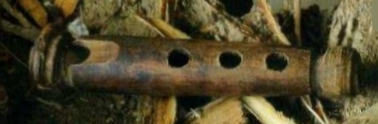 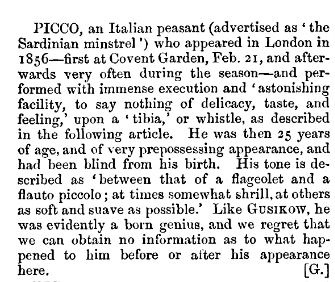 1880 review 1880 review
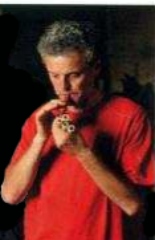
With three holes, it has an extension of eight notes plus the sensitive, obtained by combining the opening
and closing of the three holes, plus the use of the hole on the bottom. Valle Imagna, Bergamo, Lombardy,
has always produced turned objects used for everyday life. Alongside bowls,
cutting boards, tool handles,
taps for barrels, musical instruments also came out of the artisan shops These were
then sold on the stalls
of markets and fairs.
One of the last families was that of the Angiolini di Brumano. |
|
|
|
 sivli have now
been distributed to schools sivli have now
been distributed to schools
in the valley, with lessons for
students so
they can learn
to play it and also learn about
the activities
that were once widespread
in their
villages. source |
|
|
 1220-1240 book of astrology translated 1220-1240 book of astrology translated
from Arabic;
Sicily
|
|
|
1832 newspaper report from an English traveller in Messina  ‘Reminiscences of Interesting Scenes and Periods or Scraps from the Portfolio of a Travelling Batchelor ‘Reminiscences of Interesting Scenes and Periods or Scraps from the Portfolio of a Travelling Batchelor'
Liverpool Mercury - Friday 13 January 1832 |
|
1832 balls in Messina
“…balls were given at regular intervals, and one of the best attended was that of the Consul of the United States,
a member of the Society of Friends ! The public balls of the Society ...may be considered as the best specimens
of Messinese, fashionable meetings.... These delightful parties were held in the extensive refectory of a convent...
The spirit stirring sounds of the tabor and pipe but ill comported, however, with the solemnity of the adjoining
church and cloisters…”
Liverpool Mercury - Friday 03 February 1832 |
|
| |
|
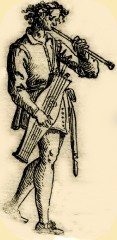
string drum - buttafuoco |
|
There are approximately fifty images in works of art where the instrument can be clearly identified, along with
some rare written information in texts from the period. Towards the end of the 16th century representations
of this instrument begin to disappear from all artistic contexts.
'Altobasso or buttafuoco, a musical instrument. Raccolta di testimonianze of the presence of the tamburo a corde in Italia' by NIERO, Loris, 2022 |
|
|
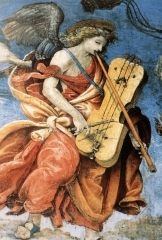 1489 fresco Rome 1489 fresco Rome |
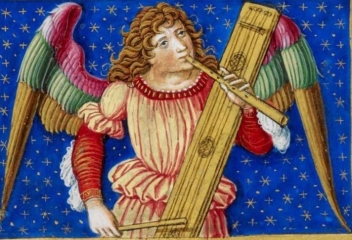 c.1490 angel, Milan, Italy [f.31] c.1490 angel, Milan, Italy [f.31] |
|
|
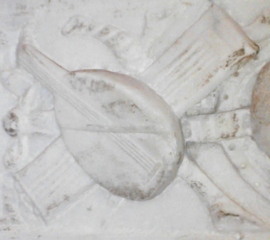 16th century bas-relief on tombstone, Naples 16th century bas-relief on tombstone, Naples |
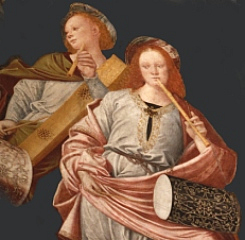 1536 'Concert of Angels, Saranno, Italy 1536 'Concert of Angels, Saranno, Italy |
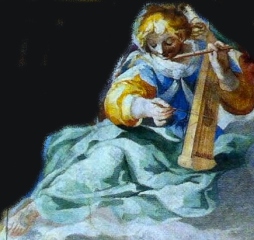 16th century Siena, 16th century Siena, |
|
|
e 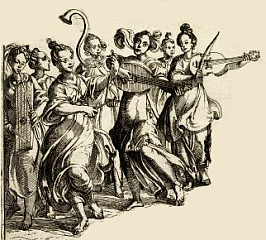 1592 1592 mythological image,' Spring', Rome |
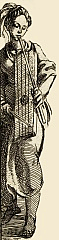 1592 enlargement 1592 enlargement
of player |
|
|
|
1537 a three-year contract stipulated in Cosenza, by the maestro Jacobo Rispoldi and the pupil Filippo Sisca.
The former undertakes to teach the pupil to play some instruments including the “buttafuoco” and the flute.
'Altobasso or buttafuoco, a musical instrument. Raccolta di testimonianze of the presence of the tamburo a corde in Italia' by NIERO, Loris, 2022 |
1570 Naples ‘The vaiasseide’, a mock-heroic poem by Giulio Cesare Cortese narrates the uprising
of the "vaiasse"
or Neapolitan servants, who want to marry against the will of their masters:
“…Then, to hold off until dusk,
They called someone with the buttafuoco…”
1574 Milan ‘The Graces of Love’ by Cesare Negri
"Contentment is represented by a young man and a lovely maiden, playing under the shade of an apple tree, both seated,
she with a small lamb in her lap. ... A shepherd followed with a buttafuoco."
1587 Florence "A buttafuoco with it’s general's drumstick"
State Archives: Medici Wardrobe, 132 c.112
1621 Florence "An old buttafuoco with it’s drumstick".
State Archives: Medici Wardrobe, 391/5 ff. 488-489
1622 Two inventories for the transfer of the Music Wardrobe from Antonio Naldi to Lorenzo Allegri, musician.
item: "An old Butta-fuoco, with it’s drumstick"
State Archives: Medici Wardrobe, 391/6 (1621), ff. 568-571 v
1627 Rome Inventory of assets
"…all of it was gathered in the house and garden to be inventoried.
In another nearby room were the musical instruments listed below.
Art 603 A Buttafoco"
State Archives: 30 Capitoline Notaries, known as Paulus Vespignanus, office 28, vol. 138, ff.574' - 588 v: 602 v- 603'
belonging to the late Cardinal Francesco Maria Bourbon Del Monte (Venice, 1549-Rome, 1626)
1628 poem
“As we know, this custom is used on the occasion of weddings… Later, on the day that the engaged couple
are going to get married, once they return home, all the relatives and friends come, and with the buttafuoco,
the flute, and the harp they start dancing.”
‘The Vaiasseida’, by Giulio Cesare Cortese
"newly enriched with Annotations and Declarations
on each Canto. With a Defense,
in which it is maintained that it is a perfect Poem
1634-36 collection of fairy tales in Neapolitan dialect;
“Day Four: And suddenly a handful of servants, who knew how to arrange things, came quickly with the cymbals,
playing drums, morrielle, citharas, harps, jingle-jams, fire-pipes, tambourines, zithers, crocro, cacapenziere,
and zuchezuche, buttafuoco”
At lunchtime, they called for the musicians [recte;buttafuochi] and began to dance with great pleasure
having made a buttafuochi, beautiful sofronia and played the Tenare de l'Abbate, Ze- zuchizuchi
and, having performed fero, Cuccara Giammartino and the Ballo de Sruorendo…"
1635 Naples
‘The Neapolitan Muses’ by Giambattista Basile
ECLOGUE III, 101 -The Talia, or The Return
“that the Harpies come quickly to take something from the table; they live on swindling and robbery,
they are the fire-blowers and the fire-blowers. [vottafuoche e rebecchine / buttafuochi e ribechini]
ECLOGUE IX, 157, 406 - Calliope, or Music.
“The concert was worth more….
The fire shovel with the siscariello, the buttafuoco with the whistle.
[lo vottafuoco co lo siscariello, il buttafuoco col fischiettino.]
… From the moment the child is born…
If he dies, he needs the trumpets; if he marries, he needs the Buttafuoco”
1650 Milan
Manfredo Settala (1600–1680), expanded and enriched a collection inherited from his father, establishing
a museum in his home. Catalogues published in 1664,1666 and 1677 contain
detailed accounts and brief
notes provided by travellers, scholars and Settala's correspondents.
Estense Library: Settaliano Museum, Campori manuscripts H 1.22, c. 34
1664 "Buttafuoco jokingly called Buttajùoco
also known to non-Africans"
1666 "A buttafuoco instrument known to Africans and much visited among Calabrians" [southern Italy]
1677
"Second edition updated with the additions that had enriched the Settala Museum in the meantime.
Regarding the buttafuoco, the text of the first edition is exactly repeated"
PIETRO FRANCESCO SCARABELLI, Collection or Gallery assembled from the
knowledge and study of Canon Manfredo Settala,
a nobleman of Milan.
Musical Instruments, Rare, and Curious: 334
"Libro per scriver l'intavolatura per sonare sopra le sordelline," by Giovanni Lorenzo Baldano, 1600
[translated by google] |
|
|
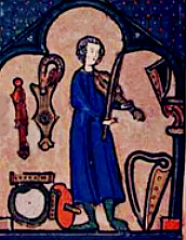
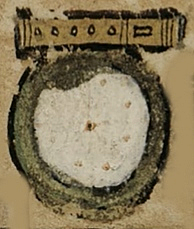

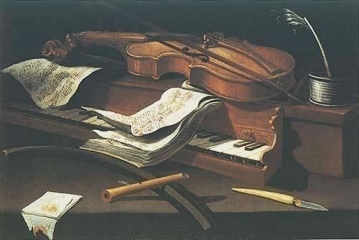


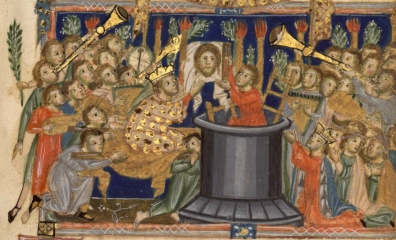
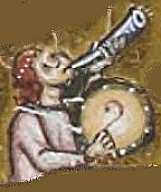



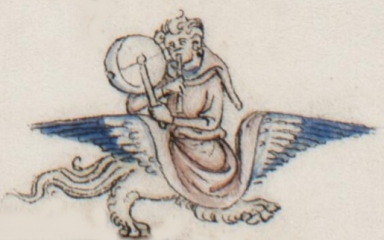
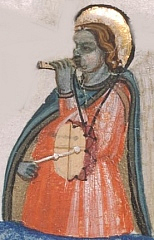
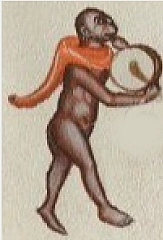
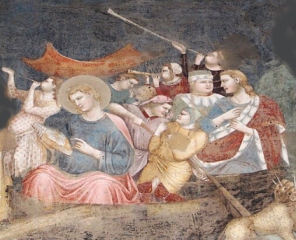
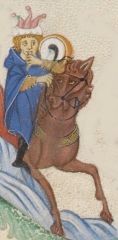
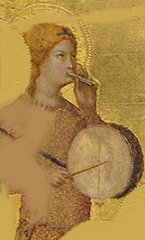

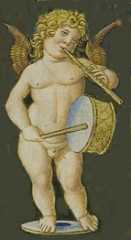
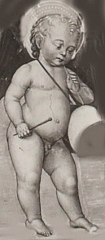
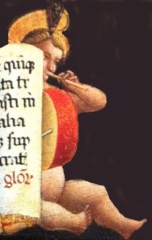
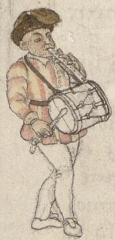 15th century
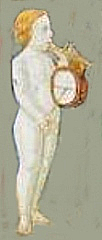
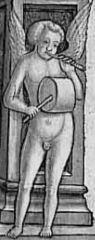
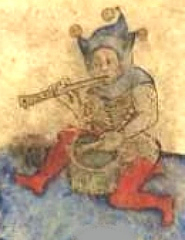
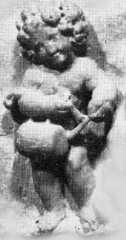
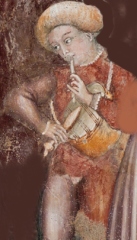
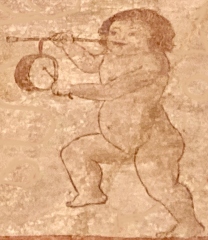
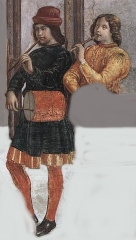
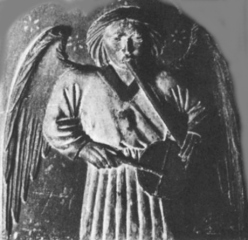
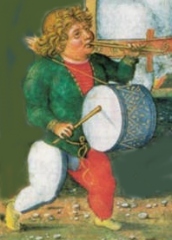
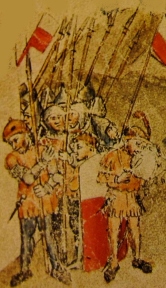
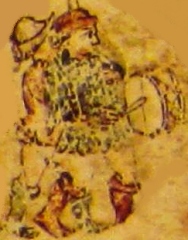
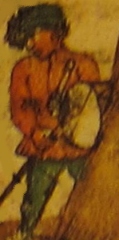
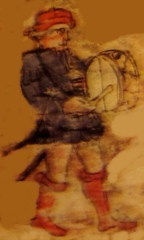
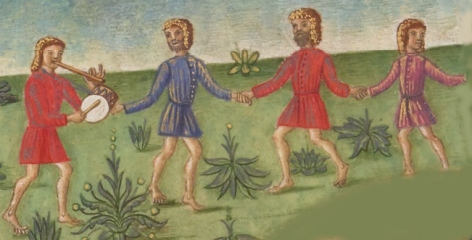
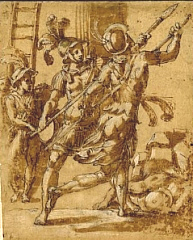
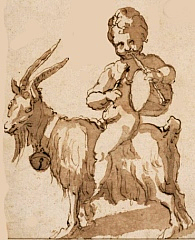
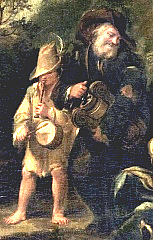
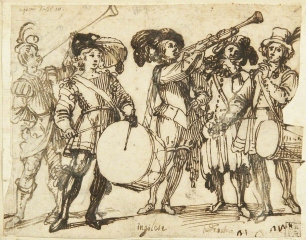

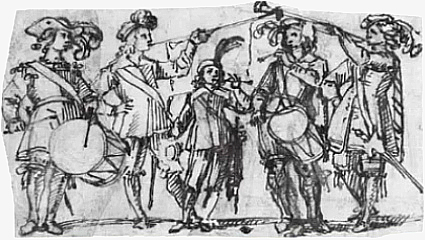
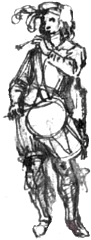
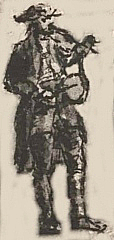
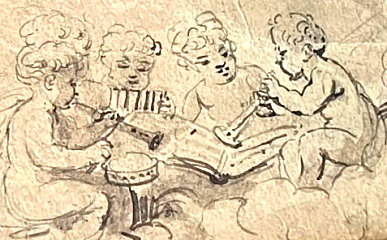
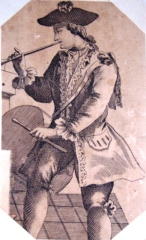
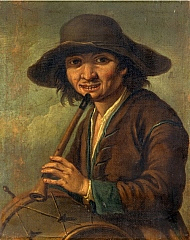
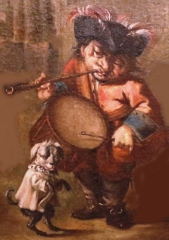


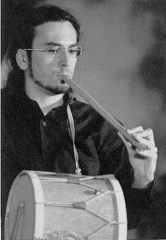
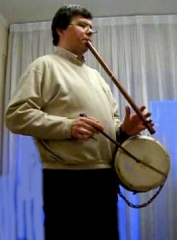

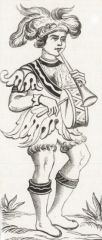
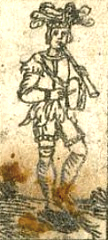
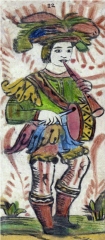
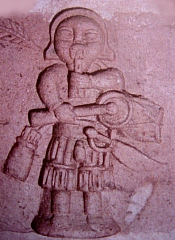

 playing





.jpg)


,_desco_da_parto_con_la_giustizia_di_traiano_e_putto_con_tamburello_e_flauto,_02.jpg)


