the Pipe and Tabor compendium

the Pipe and Tabor compendium

essays on the three-hole pipe

worldwide traditions - UK Colonies

Australia
The indigenous people of Australia do not have a pipe and tabor tradition. That was brought over by colonialists
in Victorian or earlier times. The evolution of pipe and tabor was based upon English traditions and followed
a similar path to that in England.
John Randall was born 1764 in New Haven, Conn. North America, died in Australia. 
John Randall, a Negro laborer, was tried at Manchester on 14 April 1785 for stealing a watch chain
on the docks at Liverpool. Sent to the Ceres hulk in 1786, aged 21 sentenced to 7 years transportation.

He was a crack shot.  He was made an official game keeper by governor Phillip and killed the first Emu
seen by Europeans.  In June 1799 Randall was accused of theft of plates and glasses from the governor,
but was forgiven. Randall was about 6 feet tall and well built. He played the flute and tambour.
Australia gallery here
 
Canada
Canada gallery here
 
Hong Kong
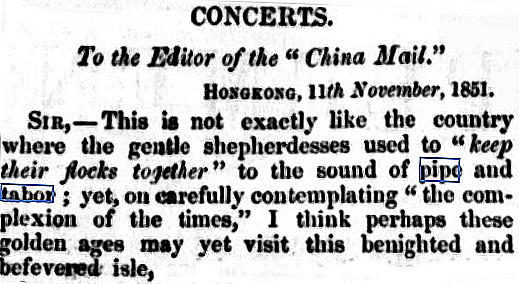
1851 1851Overland China Mail - Friday 28 November 1851
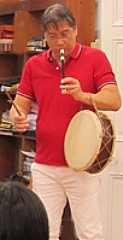
20152015 Hong Kong early music
 
India

1805 newspaper advertisement: Sales by Auction
tabour and pipe, a tambour de basque, a drum,’

Morning Herald (London) - Wednesday 01 May 1805

1807 advertised for 2nd January:
A sale of goods, imported by ship, which included wine, fabrics, haberdashery and musical instruments,
including a pipe and tabor.

Madras Courier - Wednesday 31 December 1806 (India)

1808 newspaper report of a Masked Ball
“ In our paper of last week we gave an account of the various scenes of this splendid entertainment…
merry Savoyards whose lively long and pipe and tabor bespoke them genuine votaries of the Heaven
yelep'd Euphrosyne….”

[ed. Euphrosyne is a goddess of good cheer, joy and mirth.]
Bombay Courier, volume 17 

1808 Private Subscription Masquerade
“…An excellent Group of Bacchanalians & Bashante's supporting a barrel on which was seated the rosy
God of Wine, entered the Room late in the evening, and gave a new and pleasing turn to the attention of all. …
though the procession was so unfortunately dispersed, the merry Bacchanalians continued their progress
with Pipe and Tabor….”

Government Gazette (India) 11 February 1808

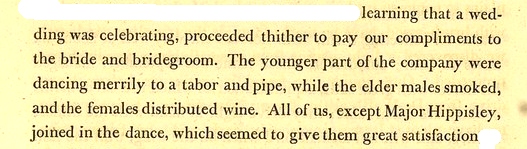
1809 'Voyages and Travels in India, Ceylon, the Red Sea, Abyssinia, and Egypt', 1809pub 1809. October 24th
1812 Venetian Fete: 1812Madras Courier - Tuesday 09 February 1813
1816 On 22nd and 28th January a supper and ball were given in India with entertainments on the pipe and tabor. 
Madras Courier - Tuesday 30 January 1816
1823 Mrs Casement's 'At Home'1823Bombay Gazette 12 March 1823

1835 newspaper report:

Pipe and tabor and dancing at festivities in Calcutta”

Bombay Gazette - Wednesday 14 January 1835; copied from the Delhi Gazette, December 17th 1834

1835 newspaper report:

“…he sees no objection to their gratulations of the Baronet with pipe, tabor, dance, and toasting
when assembled by any other person than the chief of Bailiffs….”

Bombay Gazette 14 January 1835

1837 newspaper comment: 1837Bombay Gazette 13 October 1837
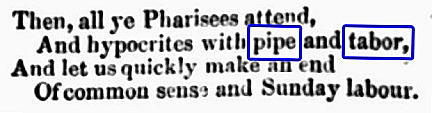
1850 poem 1850Bombay Gazette 18 September 1850
20th century 'Prints from Bengal: modernism in colonial India':20th centuryprint by Mukul Chandra Dey 
 
Jamaica

1781 advertisement regarding a 'Run Away'

RUN AWAY, from the Subscriber, a Sambo man, called BILLY, ALIAS WILLIAM HARE
"He has been for several months past in the Governor’s service, and absconded when ordered home.
He blows the French Horn, plays on the Violin, Pipe and Tabor, writes and reads, and is well known
all over the Island, pretends to be free, and has a design of getting off the Island in some of the ships
going with the next Country for England.—Captains and Masters of ships are hereby cautioned against
carrying the above- mentioned fellow off the Island, as the consequences may not only be troublesome
but dangerous.—Whoever will secure him in any of the Jails, or deliver him to the subscriber, shall receive
FIVE POUNDS reward and all reasonable Charges."

SUPPLEMENT TO THE ROYAL GAZETTE. Kingston, 2d February, 1781

1794 advertisement regarding a 'Run Away' (possible taborer)

New-Ground Estate, St. Ann's, Kingston, Jamaica

"RAN AWAY from the Subscriber, a sambo man named SAM, but calls himself SAM RILEY;
plays very well on the fife and drum, and may endeavour to pass for free; he absconded on the
25th ult. and is supposed gone to one of the towns. A reward of Two Pounds Fifteen Shillings
will be paid by delivering him at the above estate, or to Mr. Thomas Bainbridge, St. Ann's Bay. "

Royal Gazette, volume 16

1826 newspaper report on a dance:

"As it was my business to see every thing that could interest me in Jamaica, I accompanied Mr. Matthews to the Bay,
where one of these entertainments took place in the house of a free mulatto woman The music consisted of three fiddles,
a pipe and taber, and a triangle. The dancers, male and female, acquitted themselves famously well, and performed
country-dances and quadrilles quite as well, if not better, than I had ever seen at a country ball in England.”

Royal Gazette of Jamaica - Saturday 03 June 1826

1832 letter to the Editor regarding a visit to Jamaica:

“…we rambled forth, determined to have a dance wherever we might first chance to find a meeting of the kind.
Our ears were soon attracted by the merry tabor and pipe, and, after paying the accustomed admittance money
(generally fifteen shillings), we entered the temporary ball-room…
We returned, made our peace with the ball party, and passed some pleasant hours, by means of the enlivening
tabor and pipe…”

Hereford Times - Saturday 03 November 1832

1779 Kingston newspaper advertisement:

"Stationary Store, WILLIAM AIKMAN, Bookseller & Stationer, King-Street
A GENERAL ASSORTMENT OF THE BEST STATIONARY, viz.

Vellum for Drum-heads"

Jamaica Mercury and Kingston Weekly Advertiser, volume 1

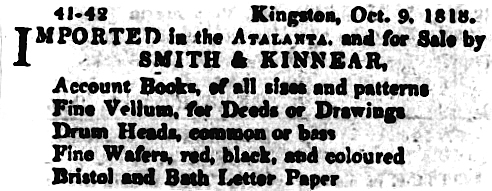
1818 newspaper advertisement for imported drum heads: 1818Jamaica Royal Gazette of Jamaica - Saturday 17 October 1818

 
New Zealand
The pipe and tabor and the pandean pipes are colonial imports to New Zealand from England.
New Zealand gallery here
 
USA
Native American:
The bone flute was used to discourage evil spirits in ceremonial use.  A four-hole Eagle bone flute
(instead of the typical five-hole flute) with its high pitch and functionality with one hand, was used
for medicinal healing, “This allowed the healer to have one hand free for passing it over the body
of the person being healed,”
(source)

London: 1624

“... Then Sir Thomas Gates, being desirous for to be revenged upon the Indians at Kekowhatan, did go thither
by water with a certain number of men and among the rest a taborer with him being landed, he caused the
taborer to play and dance thereby to allure the Indians to come unto him, the which prevailed. And then espying
a fitting opportunity fell in upon them, put five to the sword, wounded many others, ...”

JAMESTOWN: 1609-10: “STARVING TIME” GEORGE PERCY
A TRUE RELATION of the Proceedings and Occurances of Moment which have happened in Virginia from the Time
Sir Thomas Gates shipwrecked upon the Bermudes anno 1609 until my departure out of the Countrywhich was in anno Domini 1612

USA gallery here

top of page