|
|
1435 onwards; there are payment orders for the Corpus Christi celebrations in Seville to a range of musicians
including
tambourinos (pipe and tabor players), mainly in the months of May and June.
‘Musicians in the Corpus Christi procession in Seville between the Late Middle Ages and the Renaissance’ by Clara Bejarano |
1461
During a wedding in Jaén, a chronicler reported:
“there was such a great multitude and noise of drums, trompetas bastardas and trumpetas italianas, shawms,
tamborinos (pipe and tabors), drums and fools, and mace crossbowmen, and other officers of various kinds,
that no one could hear each other, no matter how close and loudly they spoke.”
‘Flutes, tambourinos (pipe and tabor), xabebas and fifes of Castile and Flanders at the dawn of the Renaissance’,
in Musicology in the 21st Century: New Challenges, New Approaches', by Ana López Suero, 2018 |
 1465 manuscript, Cordoba; page 42 1465 manuscript, Cordoba; page 42 |
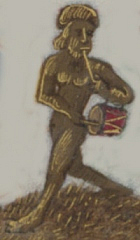 1465 manuscript, Cordoba; page 43 1465 manuscript, Cordoba; page 43 |
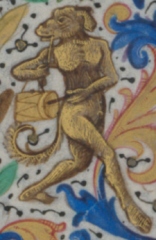 1465 manuscript, Cordoba; 1465 manuscript, Cordoba;
page 87 |
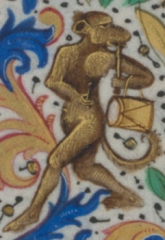 1465 manuscript, Cordoba; page 88 1465 manuscript, Cordoba; page 88 |
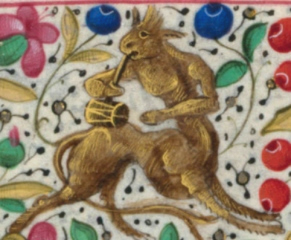 1465 manuscript, Cordoba; page 89 1465 manuscript, Cordoba; page 89 |
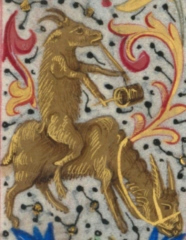 1465 manuscript, Cordoba; page134 1465 manuscript, Cordoba; page134 |
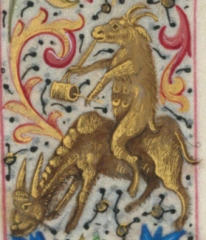 1465 manuscript, Cordoba; page133 1465 manuscript, Cordoba; page133 |
|
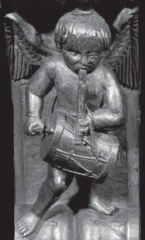 1519-1522 angel, corbel between seats 1519-1522 angel, corbel between seats
34b and 35b of the choir stalls, Jaén Cathedral |
|
|
 1570 pInting, Church of Santa Ana, Seville [Fig5] 1570 pInting, Church of Santa Ana, Seville [Fig5] |
|
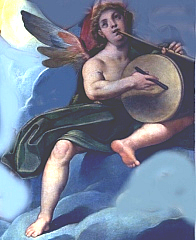 1594 painting by Pablo Céspedes Cordoba 1594 painting by Pablo Céspedes Cordoba |
 1619 painting, Medina Sidonia Palace 1619 painting, Medina Sidonia Palace
Sanlúcar de Barrameda, Cádiz |
 1634 painting, Church of Santa María de la Oliva, Lebrija, Seville 1634 painting, Church of Santa María de la Oliva, Lebrija, Seville |
 1650 Church of Santa María de la Gracia Espera, Cádiz [27] 1650 Church of Santa María de la Gracia Espera, Cádiz [27] |
|
|
|
|
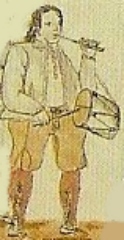 |
| 1747 drawings from 'Map of Order with Solemn Procession of Corpus Christi at Sta. Metropolitan and Patriarchal Yglesia de Sevilla ", by Nicolas de Leónn |
In 1533 Corpus Christi in Seville payments were made:
“To the high minstrels, trumpeters, drummers,  tambourinos,
and tambourine players who served at the festival: 24 ducats (9,000 maravedís)”
‘Musicians in the Corpus Christi procession in Seville between the Late Middle Ages and the Renaissance’
by Clara Bejarano |
1571 Corpus Christi in Córdoba:
a contract was signed to a tamborino for 32 reales
‘The dances of the Corpus Christi festivities in Córdoba during the 16th and 17th centuries: Folkloric, economic, and social aspects’
by
Juan Aranda Doncel |
1824 Corpus Christi, Seville 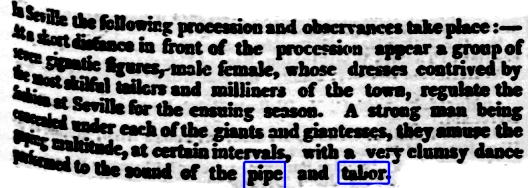 Stockport Advertiser and Guardian 11 June 1824 (England) Stockport Advertiser and Guardian 11 June 1824 (England) |
| |
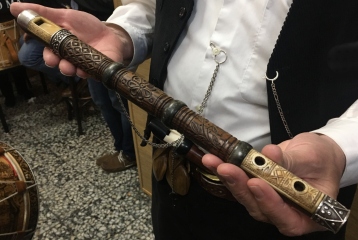 2022 Charra Rodrigo 2022 Charra Rodrigo |
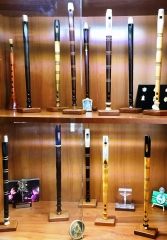 2022 Andalusian pipes 2022 Andalusian pipes |
|
 source source |
|
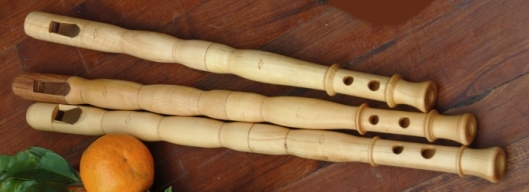 Pito Rociero / 'Rocío Whistle' Pito Rociero / 'Rocío Whistle' |
|
| |
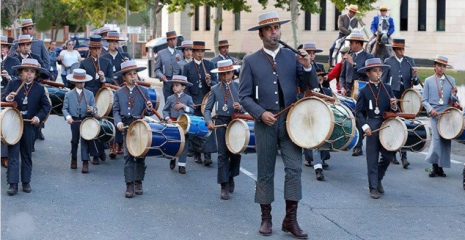
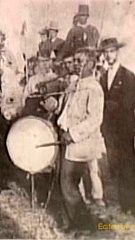
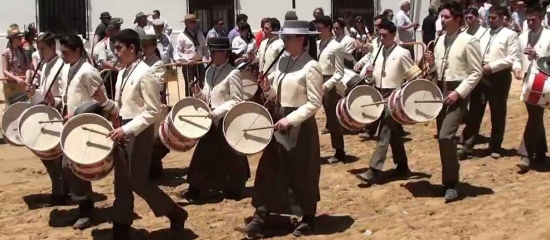
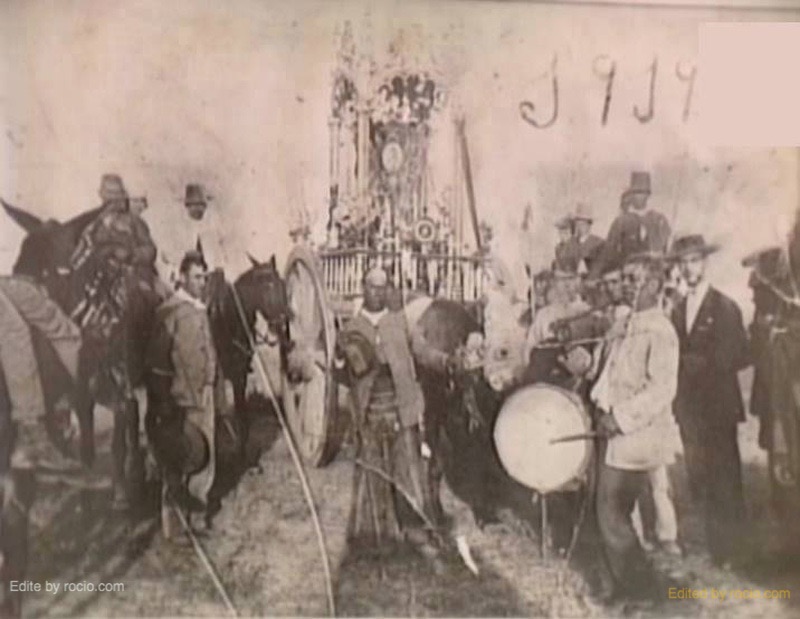
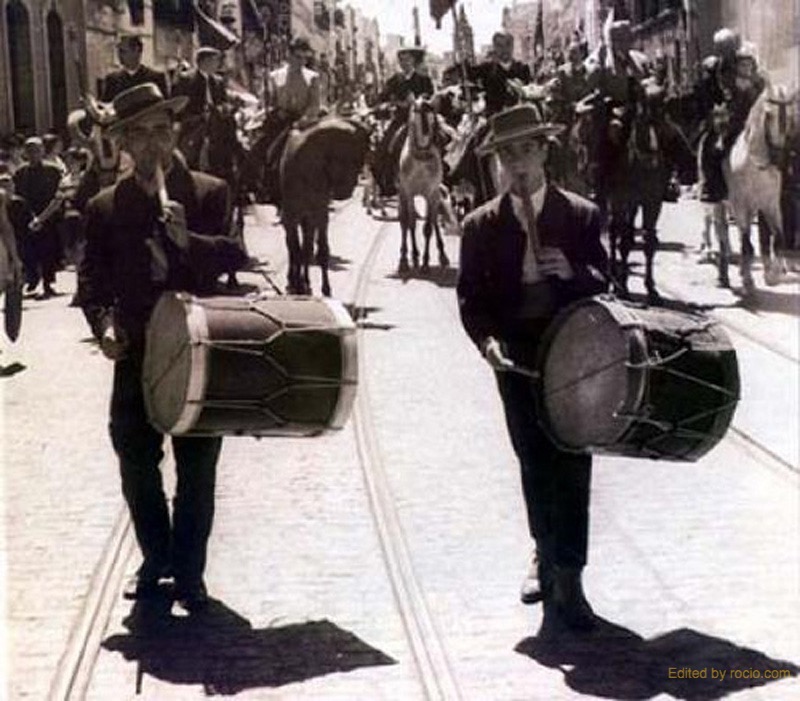
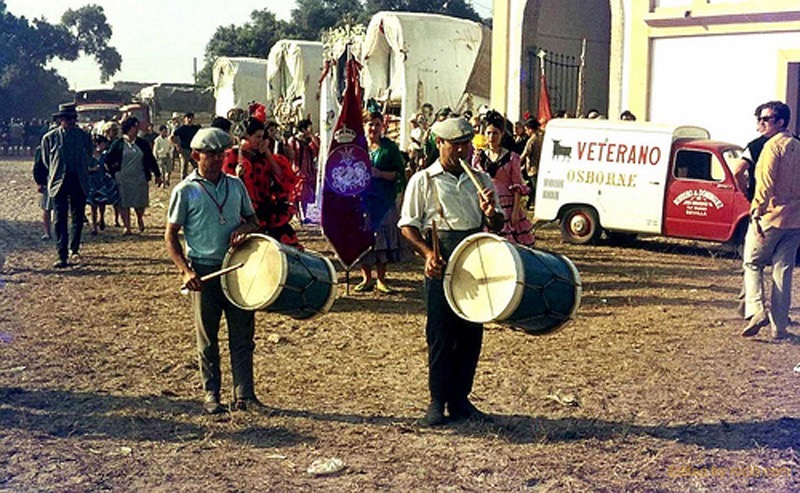
Romería de El Rocío - gaita and tamborilero at 3 day religious pilgrimage.
The Tamborilero does not merely accompany the procession; he leads it.
|
|
|
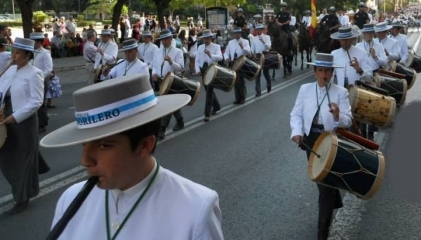 2014 Huelvas 2014 Huelvas |
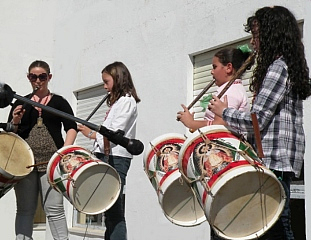
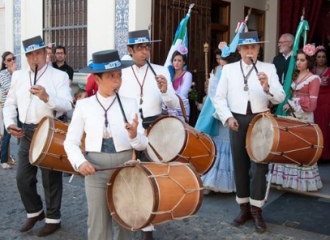 2015 “The Brotherhood of Nuestra Señora de la Bella de Lepe 2015 “The Brotherhood of Nuestra Señora de la Bella de Lepe
will soon begin a new course of its Drummers School 'Hermandad de la Bella” |
|
|
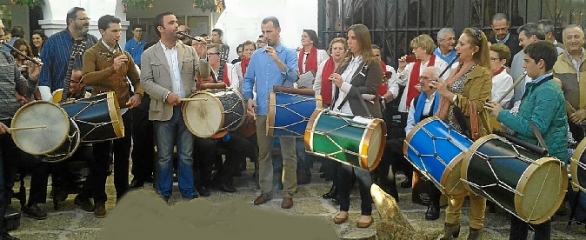 2015
Zambomba Brotherhood Rocio Huelva 2015
Zambomba Brotherhood Rocio Huelva |
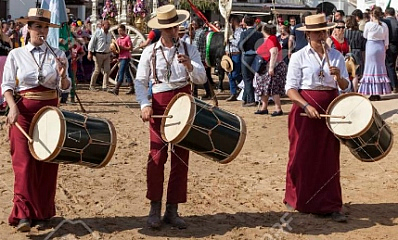 2017 El Rocio 2017 El Rocio |
 2018 El Rocio 2018 El Rocio |
|
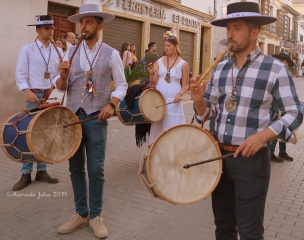 2019
Rociera Brotherhood of Malaga 2019
Rociera Brotherhood of Malaga |
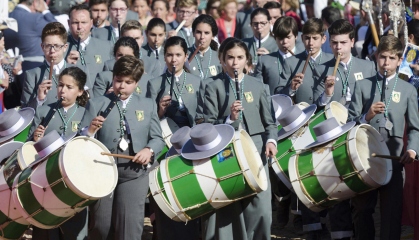 2019 El Rocio: different Hermindads [groups/brotherhoods] process to visit the church 2019 El Rocio: different Hermindads [groups/brotherhoods] process to visit the church |
|
|
|
|
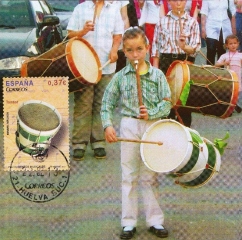 2013 postcard 2013 postcard |
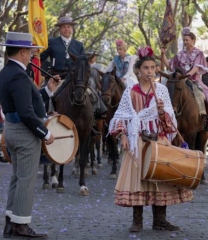 2024 Brotherhood of Rocío de Jerez 2024 Brotherhood of Rocío de Jerez |
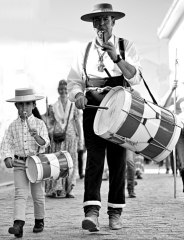 2024 El Rocio 2024 El Rocio |
|
 2001 Seville 2001 Seville |
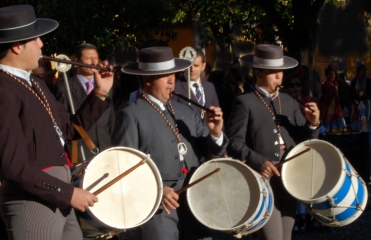 2013 Cordoba, Seville 2013 Cordoba, Seville |
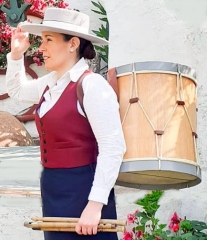 Maria Gomez Martin, Almonaster la Real Maria Gomez Martin, Almonaster la Real |
|
| |
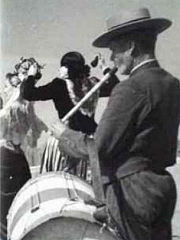
playing for dancing |
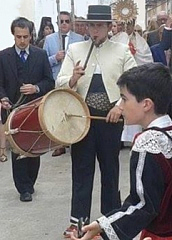
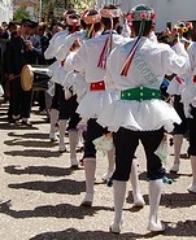
In the regions of Andévalo and the Sierra of Huelva, southwest of Andalusia, sword dances and other similar types
(lances, sticks, castanets, arches and decorative sticks) are current integrated in the celebration of a rite, a festive
and religious ceremony with solemn character, confined to local practices. The music of these dances is played
on the pipe and tabor. |
1887 sword dancers Huelva
“Both going and coming five men, expert dancers in whose families the accomplishment is passed down
from father to son, performed the Sword dance at intervals in front of the Virgin, accompanied by weird
and ancient music on the pipe and drum. This was played by a man who goes from place to place through
the country to attend similar feasts. The men dance in a line connected by swords, one man holding the hilt
and the next the point of the blade. They advance in line with a peculiar jerky step, then stop, then retreat
a little, and finally dart under one another's sword, back and forth with perfect regularity and without ever
letting go the swords”
Journal of the English Folk Dance and Song Society, Vol. 9, No. 5 (Dec., 1964), pp. 274-278 |
1964 sword dancers Huelva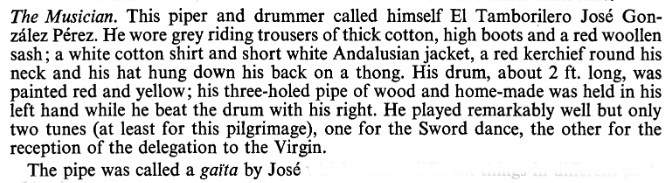 |
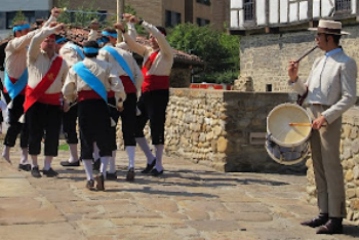 2012 musician called Jozé playing for sword dancers,
Puebla de Guzman 2012 musician called Jozé playing for sword dancers,
Puebla de Guzman
from Huelva |
|
 2017 Dance of the Cascabeleros (men only), Huelva 2017 Dance of the Cascabeleros (men only), Huelva |
|
|
 |
 |
|
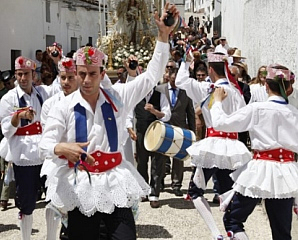
21st century, playing for
''Danza de la Tórtola'' where the men,
'lanzantes', dance backwards in procession, Hinojales, Huelva |
| |
|
 2019 El Rocio