|
Extremadura |
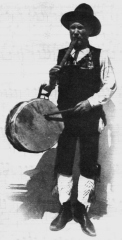
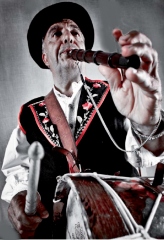
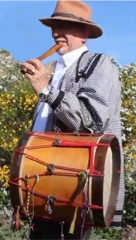
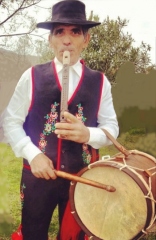
| The pipe has three holes and is made of wood, bone, or horn. The tabor is made of wood with goat or sheepskin drumheads. |
| Alejandro Bajo makes tabors and pipes: here [in Spanish] |
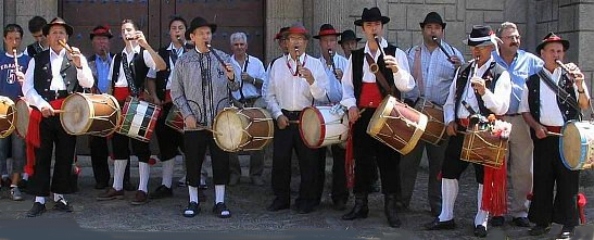 2017 Asociación cultural de tamborileros Norte de Extremadura ‘Santiago Béjar’ 2017 Asociación cultural de tamborileros Norte de Extremadura ‘Santiago Béjar’ |
1873
“it is proposed: " create a squad of young people or children and that they contribute whatever they want
to pay
for a tambourine and flute that cooperates with the greatest attention from the day before and the entire
day
of the performance.” |
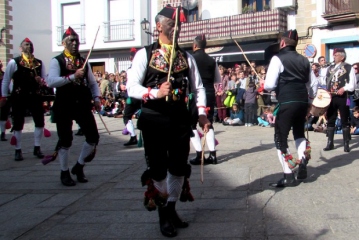
 2021 men wearing masks, ribbon dance 2021 men wearing masks, ribbon dance |
| Cáceres |
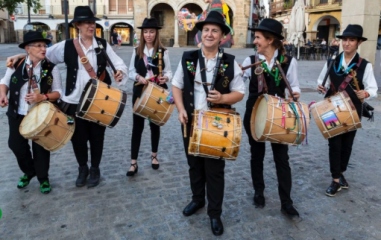 2024 women taborers from all over Cáceres 2024 women taborers from all over Cáceres
"But my father told me that was a man's thing, and over the years, look,
we've shown that we too can play the flute and the tambourine like them." |
|
" The use of the flute and tambourine has always enjoyed a relatively healthy life, especially in northern Cáceres,
and has survived to this day. In my opinion, the main reason is that the fact that it was a predominantly livestock
and pastoral region with very low economic development meant that over the centuries a traditional musician
as economically “efficient” as the taborer enjoyed great recognition."
'TAMBORILERO EN MADRID:UNA VISIÓN PERSONAL' Juanma Sánchez |
| " those who learned to play
their instruments
while almost always
being
shepherds
with their
goats
or their sheep...
also they were
and are
a whole
trunk
of oral
culture.
Tales, legends,
romances, spells,
proverbs, tongue
twisters, wit games
and a thousand other faces
of
Traditional-Popular Culture" |
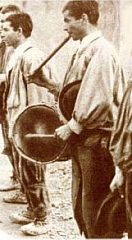 1930 Vegas farmhouse: 1930 Vegas farmhouse: |
 1941 festival poster 1941 festival poster |
 1945 festival poster 1945 festival poster |
 1968 festival poster 1968 festival poster |
|
|
|
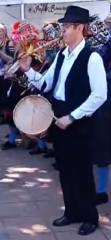 2024 Sergio Gonzalez Fabian 2024 Sergio Gonzalez Fabian
playing
for dancers
at the
Artisan Market |
|
|
“…we have met in the town of Montehermoso a villager who enjoys a certain prestige
in the region as a pipe maker. We witnessed how he made them one afternoon, and we
were able to verify that he only measured the length of the tube, the diameter of its inner
bore and the notches of the mouthpiece or embouchure “by eye”, trying, of course,
to make the three holes for modifying the sound that were equally spaced between them.
This system is commonly followed everywhere, apparently; thus, we have had several
cases of finding flutes out of tune in almost all their intervals…”
‘DULZAINA, GAITA AND FLUTE, THREE POPULAR INSTRUMENTS
Brief introductory study to a collection of ‘New music for old instruments’ |
| Plasencia - Gaita y tamboril |
 early 16th century misericord early 16th century misericord
Plascencia Cathedral |
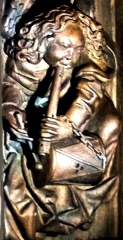 early 16th century misericord early 16th century misericord
Plascencia Cathedral |
 1688-1691 organ, Plascencia Cathedral 1688-1691 organ, Plascencia Cathedral |
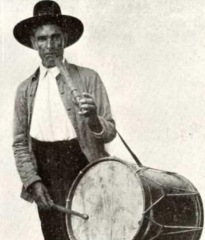
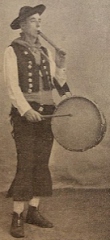 1916 Mariano Gómez Bautista 1916 Mariano Gómez Bautista |
|
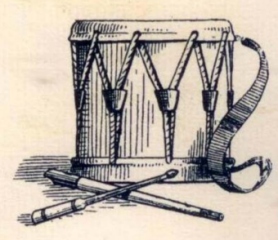 1944 cover of book by Manuel García Matos [detail] 1944 cover of book by Manuel García Matos [detail] |
In the 1930s, the folklorist (and accomplished taborer) Manuel García Matos collected more than two hundred
flute and tambourine melodies here for his songbook Lírica Popular de la Alta Extremadura, which he almost
miraculously managed to publish in 1944. |
|
|
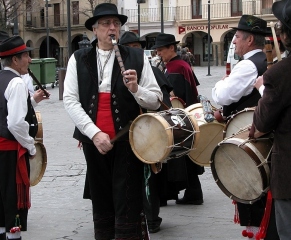 2006 group playing on the day of San Fulgencio 2006 group playing on the day of San Fulgencio |
|
|
|
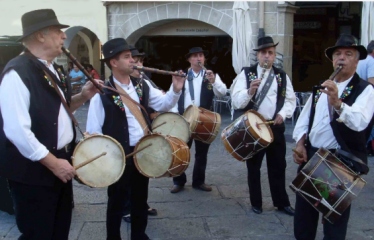 The Campomaior Flower Festival The Campomaior Flower Festival |
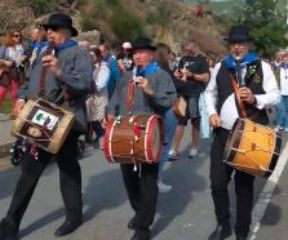 2023 procession
celebrating 'The Virgin of the Port of Plasencia' 2023 procession
celebrating 'The Virgin of the Port of Plasencia' |
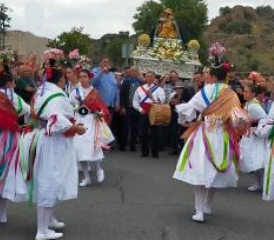 2023 religious procession 2023 religious procession |
A pipe and tabor course at the Universidad Popular, means an increasing number of women
and young people are being trained, which guarantees the renewal of such a traditional art form. |
|
|
| Las Hurdes |
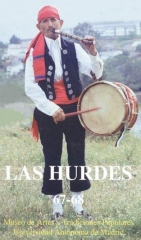
music from Las Hurdes |
|
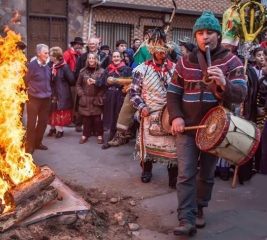
 1922 playing for dancers from the Aceitunilla farmhouse 1922 playing for dancers from the Aceitunilla farmhouse |
|
 Wood pipe painted black. It has metal reinforcements on the mouthpiece and the lower end and 6 other metal rings Wood pipe painted black. It has metal reinforcements on the mouthpiece and the lower end and 6 other metal rings
for reinforcement. |
 wood pipe from Nuñomoral. Both ends reinforced with black plastic rings. It has 5 more rings between the two ends. wood pipe from Nuñomoral. Both ends reinforced with black plastic rings. It has 5 more rings between the two ends. |
"The best wood for pipes is holm oak heartwood.
The bezel is made from the wood itself, or with a metal plate,
or on a piece of bone or horn that is glued to it. ...There are also pipes made from the bone of a vulture's wing,
completed with pieces of goat horn. Then the ferrules or "encergas" (rings) are attached, made of metal (iron, brass,
sometimes silver) or horn.
Traditional Hurdan gaitas do not have a unified tuning.
The tabor was formerly made from the trunk of a cherry or chestnut tree, hollowed out with sharp tools until
they had a wall about two centimeters thick. … Currently, almost all are made from plywood.
The stick is made from a hardwood, such as olive or arbutus. The drumstick is most often turned on a lathe,
but there are also those made with a knife. "
‘LA GAITA HURDANA’ by Óscar Duarte Canuto |
|
"The reputation for being womanizers, always, and for drinkers—not drunkards, you can't play if you're drunk
—haven't prevented taborers from always enjoying high social esteem..
In the past, the pipe and tabor was only for men, and now there are some women who decide to play, but they're few.
… some girls and women attend the music schools, but they don't usually finish or even end up playing."
‘LA GAITA HURDANA’ by Óscar Duarte Canuto |
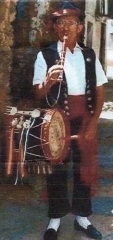 Jesus Crespo, died 2005 Jesus Crespo, died 2005 |
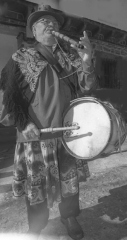 2011 2011 |
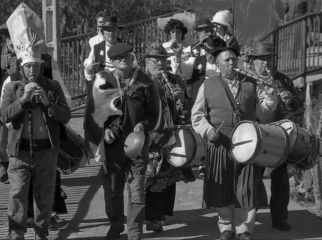 2011 procession 2011 procession |
|
|
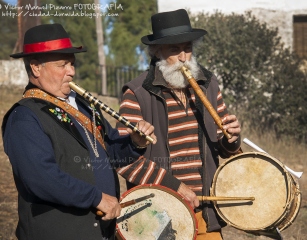 2013 La Carvochá and La Chicharrona Festival 2013 La Carvochá and La Chicharrona Festival |
 2014 Carvochá and Chicharrona Festival 2014 Carvochá and Chicharrona Festival |
|
 2014 Tío Manuel 2014 Tío Manuel
from Cerezal,
Nuñomoral |
|
|
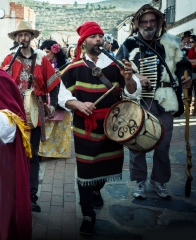 2017 carnival 2017 carnival |
 2019 roasting chestnuts 2019 roasting chestnuts |
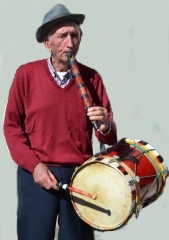 2021 Marcial Guzmán Martín 2021 Marcial Guzmán Martín |
|
 2022 slaughter of animals procession 2022 slaughter of animals procession |
|
|
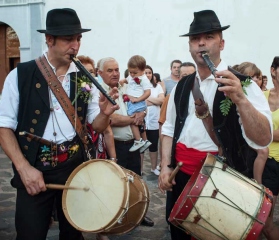 2021 La Enramá Festival, Pinofranqueado 2021 La Enramá Festival, Pinofranqueado |
 2021 La Enramá Festival, Pinofranqueado 2021 La Enramá Festival, Pinofranqueado |
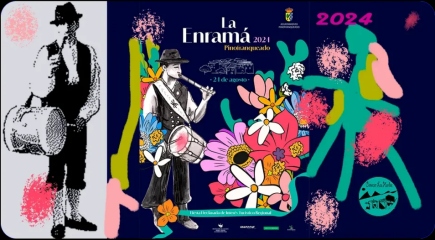 2024 La Enramá Festival poster,
Pinofranqueado 2024 La Enramá Festival poster,
Pinofranqueado |
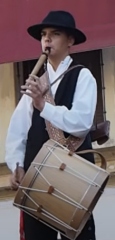 2024 Mario Sánchez 2024 Mario Sánchez
from Pinofranqueado |
|
|
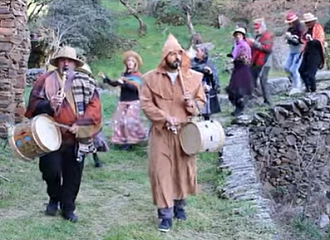 2025 Las Hurdes Carnival, which rotates around different villages 2025 Las Hurdes Carnival, which rotates around different villages |
 2025 Traslaera Folklore Group from Pinofranqueado and Alquerías 2025 Traslaera Folklore Group from Pinofranqueado and Alquerías |
|
|
| |
|
Badajoz |
Extracts from an interview by Fernando Pachón in 2022:
Corpus Christi is the main festival of the Extremaduran town of Fuentes de León.
"We'd usually wait for the tamborilero, who usually arrived around seven because, of course, back then
he wasn't from the village; he had to come from Cum... from Hinojales, a village in Huelva...[He wears]
clothing like, it looks like the style of Charles III, with baggy trousers, with a hat like they wore back then.
He plays the flute, and he's the only one... the drum and the flute.
the tamborilero would be out there playing all night, right? And then he'd go to the bars, people would invite him,
he had groups, and he'd play, and everyone would dance. And it's still done, uh... does the drum still go from
bar to bar? E: Yes, yes....I remember at my house, since we lived in the square, we were surrounded by bars,
and so maybe you'd see the tamborilero guy in a bar at four in the morning, completely wasted, because they
used to drink
The tamborilero has been here for about four or five days, now the same guy is from I think Aracena, or from
a town next to Aracena, in the mountains. So he comes here and is here all day. He's there all day Thursday,
and all day Sunday, those are the two days the older dancers come out, ...Because then on Saturday and Monday
the younger dancers come out, so I imagine they have to pay the tamborilero. In the old days, the wealthiest
person or family would pay him, the one who had the means, the one who kind of covered the costs of the festival.
Wednesday, which was kind of an intermediate day, because on that day I remember seeing the steward pass by
my house, on my street, and the tamborilero would pass by, that afternoon he was going to pick up the steward
and go to the church and bring the banner..."
‘Interview about the Corpus Christi festivities in Fuentes de León, Extremadura’ by Fernando Pachón, 2022 |
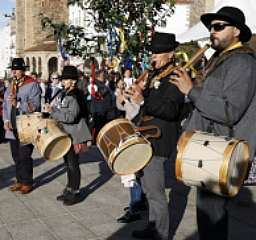
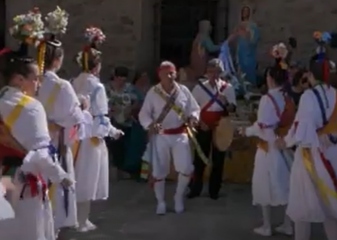
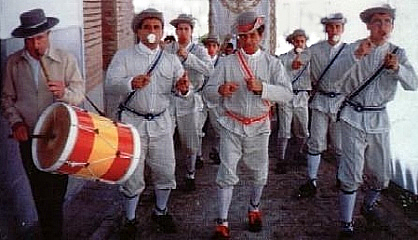 21st century playing for 'The Older Dance' in Fuentes de León 21st century playing for 'The Older Dance' in Fuentes de León
(The men have carnations in their mouths) |
|
|
 2011 Fregenal de la Sierra, page 236 2011 Fregenal de la Sierra, page 236 |
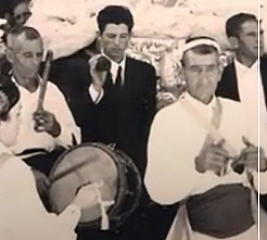
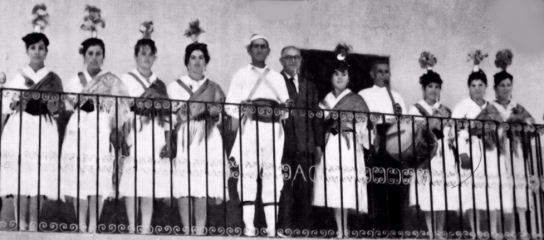
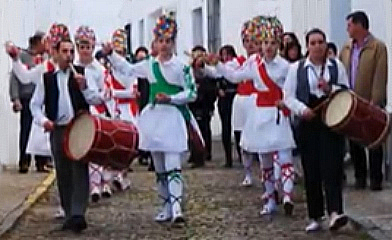 date not known date not known; Fregenal de la Sierra; male and female players |
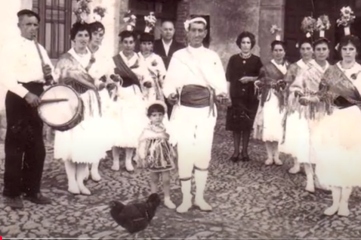
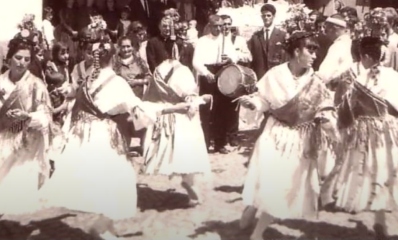
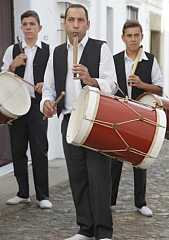 date unknown, playing for
Virgin of Health Dance date unknown, playing for
Virgin of Health Dance
Fregenal de la Sierra |
 2015 poster advertising folklore workshops, Valdivia 2015 poster advertising folklore workshops, Valdivia |
|
| |
|
|

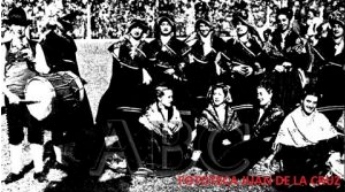
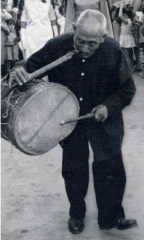
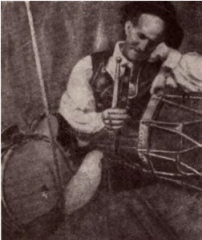

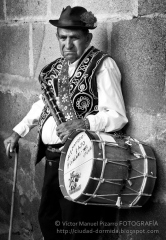
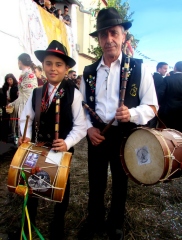
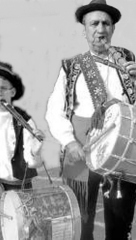













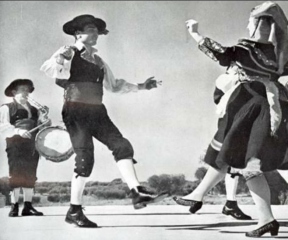 playing for