Europe: 19th to 21st century France
under construction
19th century
pipe 1801 - 1900 Dolmetsch Collection
1911 Landes, Nouvelle-Aquitaine
A classical piece of music called 'La tempête' written in 1888 by Ernest Chausson contains a section 'alleggretto leggiero'
which is said to be a flute and tambour duet.Hidden Treasures series, at 9.50 minutes:
The tabor reappears from time to time in the modern orchestra as the tambour or tambourin provencal. Bizet employed
it in L’Arleé- sienne Suite no. 2 (1872), Copland in El Salén México (1933-36), Milhaud in his Suite frangaise (1944),
and Sessions in his Symphony no. 3 (1957).'The New Harvard dictionary of music', 1986
‘Observations on the social and political State of the European People in 1848 and 1849;
being the second series of "The Notes of a Traveller." by Sam Laing1871 re-drawing of 14th century manuscript
‘A History of domestic manners and sentiments in England during the Middle Ages’ by Thomas Wright
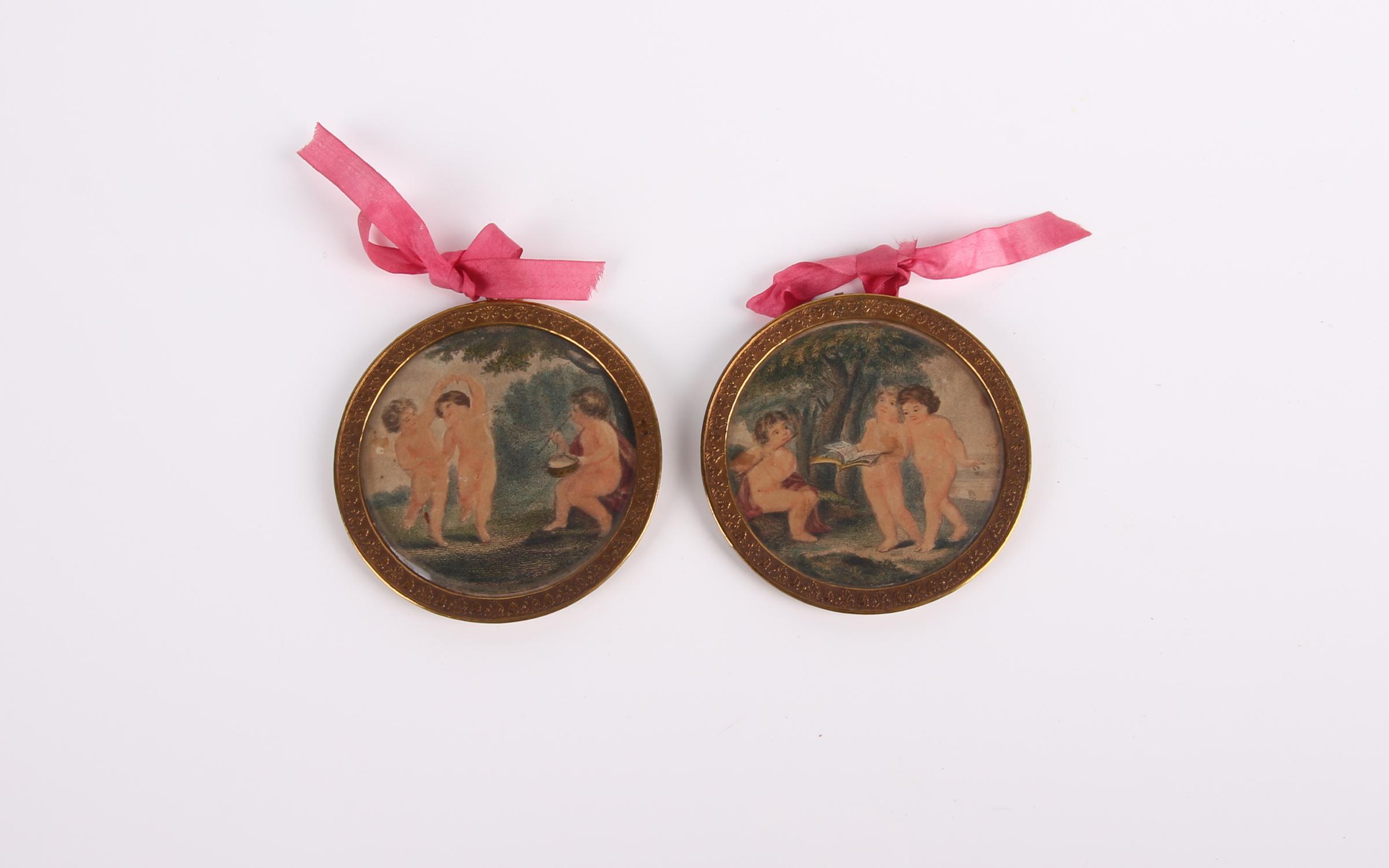
19th century putto statuette
19th century sculpture
19th century silver statuette
late 19th century gilt bronze statuette
before 1820
children's illustration1820 Saint Cloud Festival, Paris
19th century painting
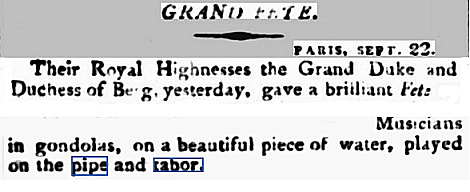
Morning Herald (London) 08 March 1827 - 1827 Bordeaux, Nouvelle-Aquitaine
1828 watercolour, Brittany
1830 Opera ‘Fra Diavolo’
CHORUS OF PEASANTS
"...Come, young girls, come,
come, we must be going.
Pipe and tabor
beckon us at pleasure's call."1834 caricature, taborer mounted on a goose
“SAVOY AND SAVOYARD
… in sober reality, rarely, either in summer
or winter, will rustic dance
or song here be found to enliven
morning or evening: rarely will
the sound of pipe or tabor be found
to greet the traveller's ear, or the voice
of merriment be heard to issue from
cabin or cottage to invite his stay. During the winter months, the condition of this peasantry must be pitiable indeed….”Bolton Chronicle 24 January 1835
1840 painting, Aquitaine, on the border with Spain
1843 church wood carving, Saumur
Pays de la Loire1846 Épinal, Grand Est
© Musée de l'Image - Ville d'Épinal19th century Paris
19th century
before 1847 Bourgogne-Franche-Comté
1843 story:
“… It was a holyday, and the peasants were celebrating it by a dance in the open air. A pipe and tabor
formed their whole orchestra, but these were quite enough to keep their feet in motion. Joy shone in every face…”‘Paul de Kock’s Novels: Sister Anne’ in The North American review. 56. 1843
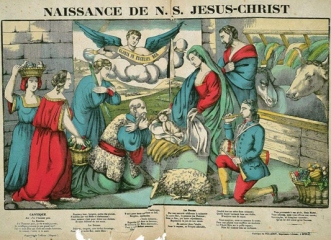
1849 nativity scene, Metz
© Musée de l'Image - Ville d'Épinal / photo E. Erfani19th century nativity
1840-1890 nativity
mid 19th century painting, nativity, Alsace
1857 Paris
1857 farandole on pentecost Monday, Occitanie; l'illustration-journal-universel-no-745-volume-xxix-june-6-1857
1865 newspaper report, Laruns, Pyrénées-Atlantiques Berkshire Chronicle - Saturday 30 December 1865, England
1867 newspaper article ‘The Empire and the Exhibition’:
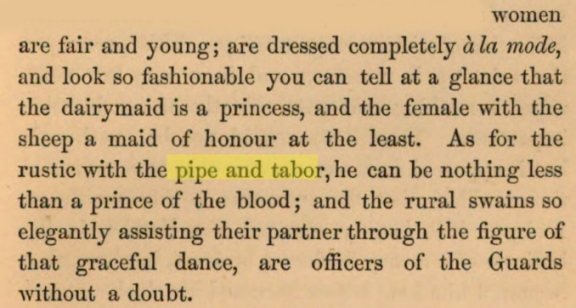
“…Prince Imperial was sick and suffering; and the grand Ceremonial Inauguration was
not with pipe and tabor , trumpet and cannon, but shabby, hurried, and dispirited….”The Saturday Review, London. 4/20/1867
1869 fantasy painting
playing for dancing pigs1879-1882 toy theatre, printed at Metz
1883 opera poster
1885 stained glass window
Passy, Paris1890 from a design book by Ernest Guillot, page 132
1890 sketch for Paris City Hall:
medieval scenes1891 wedding procession
1898 story 'The Ball Programme''
‘Stories for Ninon’ by Zola, Emile, 1840-1902
“…a pipe and tabour were heard, and the breeze brought us the subdued sound of dancing….A thin,
raw-boned man, leaning with his back against an oak-tree, was playing the pipe, whilst he struck a sharp
-sounding tabour with his left hand, after the custom of Provence… and it was not without anger that he
saw these inhabitants of the inner country thus breaking all the rules of fine dancing. Aggrieved during
the quadrille at the leaping and stamping of the peasants, he blushed with indignation when, at the end
of the air, they continued their paces for five long minutes, without appearing to have any idea even
of the absence of the pipe and tabour….The player on the pipe, who had pretended to withdraw,
having seen a few pieces of money shine, had just taken to his instruments again, beating and blowing
afresh, whilst sighing at the thought of prostituting melody as he was doing….”1898 story
“I send you Buisson, the tabour-player; pilot him," and the innumerable series of mishaps Buisson
‘Behind a mask; or, Numa Roumestan’by Daudet, Alphonse
and I met with on account of his flute, in Parisian salons, theaters, and concerts….The little flat case
contained his, galoubet, the simple rustic flute, which goes toottoot, while the drum goes boom-boom!
The covered cylinder was the drum itself. What a drum, my friends! Tears came into my eyes when I
saw it uncovered; an authentic tabour of the time of Louis XV., at once touching and comical in its enormity,
grumbling like an old man at the least touch with the tip of a finger. It was made of fine walnut, ornamented
with delicate carving, polished, thin, light, sonorous, and seeming to have become supple with the tempering
of time. Serious as a pope, Buisson slung his tabour to his left arm, took the pipe between three fingers
of his left hand (you have seen the pose and the instrument in some engraving of the eighteenth century,
or on the bottom of one of old Moustier's plates), and operating with his right hand the little ivory-tipped
drumstick, he touched the big drum, which, with its continuous sound like the burr-r-r of a harvest-fly…1898 ballet, Paris
1937 etching, Paris
early 20th century ttun ttun from a postcard
1855 Branle d'Ossau
2015 string drum
1841 caricature, Paris






top of page