Europe iconography: France - Provence
A Short History of the Galoubet/Tambourin
Europe iconography: France - Provence
A Short History of the Galoubet/Tambourin
by Nick Blanton
"The tambourinaire, who plays both a melody and percussion, has become one of the symbols of Provence. Its uninterrupted presence, from the central Middle Ages
to the present day, provides us with a rich repertoire ranging from the music
of the troubadours to contemporary compositions, including Renaissance
Baroque, Classical, and Romantic music."
In the Middle Ages and Renaissance the pipe and tabor tradition extended over most of western Europe. In Provence, during the 18th century, these instruments evolved into the galoubet (pipe)
and tambourin (drum) that continue to be played today.The tambourin and galoubet are associated with all significant events in the life
of an individual, the family, a congregation, the community, the region and the country.
They are especially involved in calendar festivals (Mardi Gras, Easter, May, harvests,
grape harvests, vigils, Christmas, etc.) and rituals (birth, childhood, conscripts, weddings,
death). So the repertoire shows an extraordinary diversity.
1683 “the religious in Marseille all carried the rich banners of the saints of their brotherhoods:
the flutes, fifes, and tambourines, which accompanied each banner, served to awaken the dedication
of the people.”‘Explanation of the Uses and Customs of the People of Marseille’, by Abbé Marchetti
quoted in ‘Tambours-bourdons en France au XVIIIe siècle’ by Florence Gétreau, 200517th century: ‘tambourin’ is defined as: "An instrument played with only one stick..."
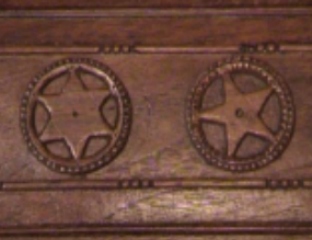
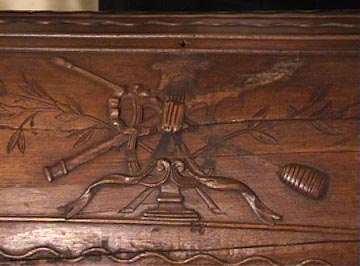
third edition of the dictionary of the Académie FrançaiseUntil the late 17th century the drum had no decoration. Carved decorations were added
to the wood shel from the end of the 18th century, with the arrival of Classicism.Initially various sizes of drum were used. But by the middle of the 18th century the long tambourin
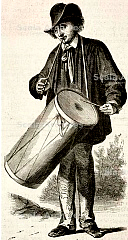
had become the preferred drum in Provence and surrounding area.originally drawn in 1730's
18th century tambourin
1878
1889
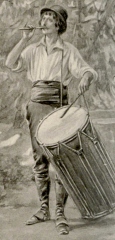
19th century
1900 photograph
early 19th century tambourin: close-up of decoration
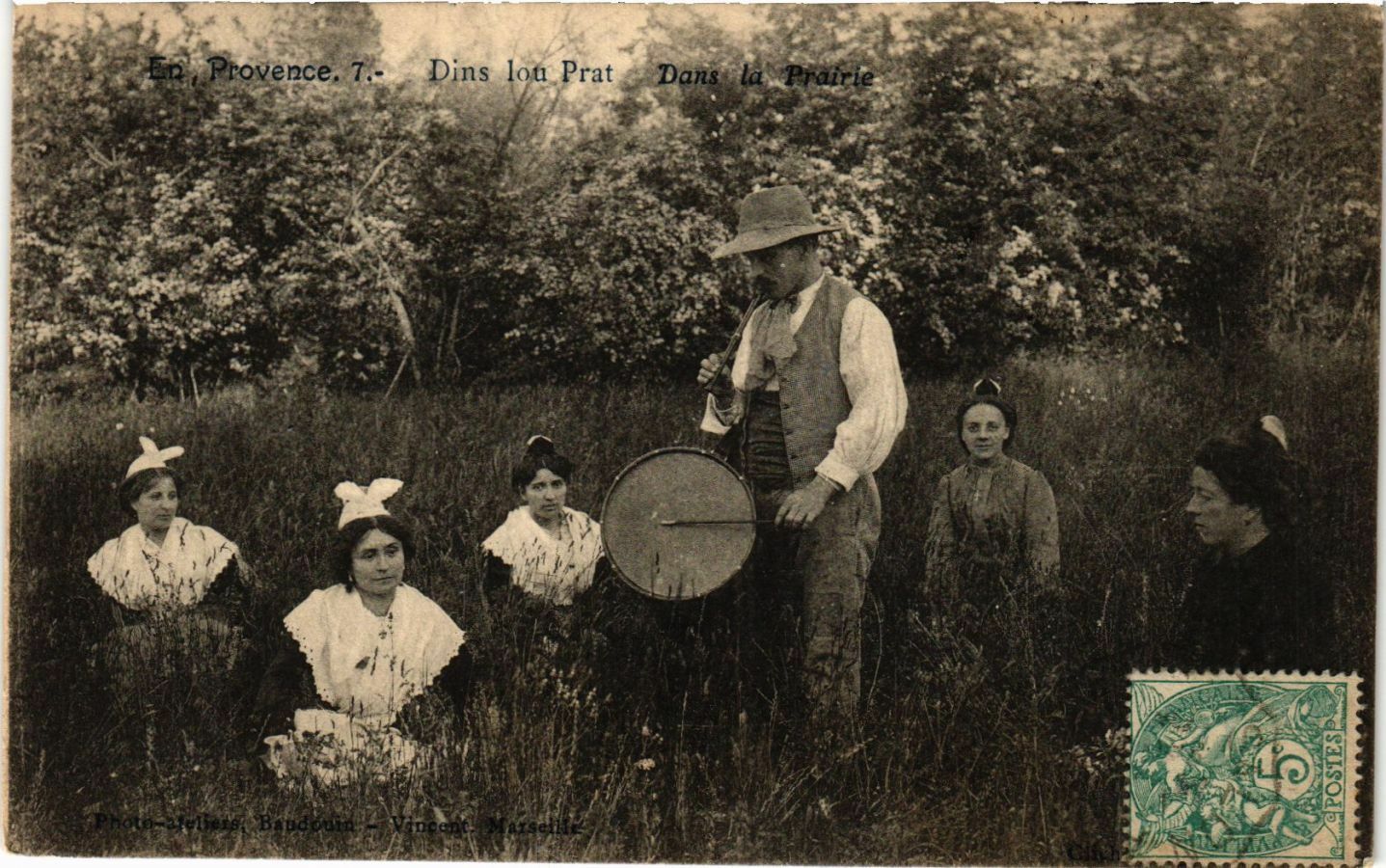
1907 postcard
1929
21st century Jean Pierre Miaule
tambourinaire, Côtes d'Azur21st century tambourin decoration
The snare, one of the most important elements of the tambourin, helps to make its characteristic sound.
An extremely fine cord (hemp lace 6/10 mm in diameter), is stretched over the top skin to make
the continuous buzzing resonance.
of the tambourin under the strap. This is the acoustic vent and regulates the internal pressure
of the instrument.The galoubet and tambourin (along with the hurdy-gurdy and bagpipe) were adopted for fashionable
high-class genteel pastoral entertainments across France during the 18th century.In the inventories of Parisian luthiers, who were often also dealers in various instruments that
they did not produce themselves:1756, December 24, Claude BOIVIN, "One tambourine," six livres.
1760, February 15, Jean-Nicolas LAMBERT, "Five tambourine cases," 30 livres.
1772, March 26, Widow of Pierre LOUVET, "Two tambourines, one with skin, valued at six livres
and the other with string, valued at one livre ten sols."
1787, January 12, Joseph GAFFINO, "Four tambourines, two with strings and two with sticks," 4 livres "For the same period, advertisements, posters, and various notices testify to the continued interest,
which only declined in the 1780s:
1757, May 9, a Marseille tambourine with several flutes."
1760, September 4, "magnificent Marseille tambourine with a box, very ornate."
1763, June 16, a tambourine with its flutes."
1777, December 11, "two beautiful tambourinesfrom Provence in a new style. At the home of Sieur Châteauminois, haberdasher, rue de Grenelle-St-Honoré, near rue du Pélican."
1779, January 31, Provençal tambour trimmed with silk.
1781, March 15, Marseille tambourine, one scule piece, 12 livres.Parisian inventories for string drums:
1758, January 25, Louis GUERSAN, "Two stringed tambourines," 12 livres each
(a flat-backed guitar is worth 24 livres and a small violin 6 livres).
1760, February 15, Jean-Nicolas LAMBERT, "Four stringed tambourines," 27 livres together.
1784, January 22, Pierre LOUVET. "Basque tambourine," 1 livreGaloubet newspaper advertisement:
1764, February 16, "Two galoubets for the tambourine, one of ivory and the other of ebony, each
composed of a (?) body, in very neat cases; and a stringed tambourine, with two sides that can be
set to two different tones.‘Tambours-bourdons en France au XVIIIe siècle’ by Florence Gétreau, 2005, pages 79/80, 84
Over time this design became more and more a feature of Provence. Weddings, dances
and festivals typically had one or more tambourinaires. The galoubet was developed so it could
be played chromatically with a fairly wide register and so was able to play the sophisticated marches,
minuets and contredanses published and distributed throughout the region.In the mid 19th century there was a whole Provençal cultural revival, notably in urban areas such as
Marseille. So the galoubet/tambourin repertoire acquired the popular dance music of polkas, waltzes
and the often complex and arpegiatted styles. These are still popular today.Currently there is another revivial. The instruments are taught in numerous schools.
2016
2017 festival on the Cours Mirabeau
In the 21st century the repertoire has been broadened to include much early music, like the 16th
century noëls in the collection of Notre Dame des Doms in Aivignon, and modern compositions.
Maurice Guis, among others, has created music for ensembles and for galoubet/tambourin and piano.'Le Galoubet-Tambourin - Instrument traditional Provence', by Guis M., T. Lefrancois, R. Venture, 1993
The history of galoubet-tambourine-type instruments of the musical tradition of Provence. This book highlights both the instruments
themselves and their factors, their repertoire and instrumental practice of the classical period to today. It just as useful for learnin
g about the folk traditions of Provence as for specialists.Electric bands mix galoubet/tambouri, or galoubet on its own with electric bass, guitar, synth
and drum kit to create a strong Occitan / Provençal identity.The galoubet has three holes (two on top, one underneath). The most expensive instruments
have mouthpieces and ferrules of bone or ivory.1723 'galoubet' is first mentioned in the 'Dictionnaire Provençal et Français' by S A Pellas,
which mainly represents the dialect of Aix-en-Provence.18th century painting
'Portrait de Jeune Tambourinaire'
18th century pipe
1770 alternative tuning joints enabling the galoubet to play in tune with other instruments
early 19th century boxwood and ivory galoubet
20th century galoubet
galoubet
Pyrenees pipe - the duct is reinforced by a small metal plate.
By the later 18th century the tuning of TTT had become most common for the galoubet. The tuning of what
became the galoubet was the common TT 1/2T of the tabor pipe. In the 21st century there is again a diversity
of sizes of instrument. Generally the most common galoubet for ensembles is that tuned TTT, starting on C5.
Possibly the next popular is a lower one tuned TT 1/2T, starting on G4.
instructions for the flute, piccolo, flageolet, tabor pipe, oboe, clarinet, bassoon, trumpet, French
horn and serpent. It was republished in 1813.1864 music book
An example of 20th century galoubet music by Henri Tomasi, published in 1960:
'Sinfonietta provencale Le tombeau de Mireille : pour galoubet, ou petite flute, ou hautbois
et tambourin, ou caisse claire detimbree, ou piano"Royal Academy of Music, London
drumstick (masseto)
Some massetos are very elaborate and may be of ebony and ringed with bone or ivory. The massettos
can even hide a perfume sponge (lavender essence) which is said to relieve the nostrils of musicians
when they passed through smelly neighborhoods.“In mid-18th century France, a peculiar fashion arose among the nobility of glorifying the “simple“
peasant lifestyle, the idealized image of which was duly imitated in aristocratic circles. In the
seclusion of grandiose palaces, stylized village and shepherd music and instruments were played
and danced to, which had only little in common with actual rustic music and dance”
the beginnings of ballet
1766 letter from an English traveller on the people of Nice:
“they assemble after service, men and women, in their best apparel, and dance to the musick of fiddles,
and pipe and tabor, or rather pipe and drum. There are hucksters' stands, with pedlary ware and knick
-knacks for presents; cakes and bread, liqueurs and wine; and thither generally resort all the company of Nice.”‘Travels Through France and Italy’ Tobias George Smollet page 324
1813 Nice
“…If the peasants in the neighbourhood of any chapel dedicated to a saint, whose day is to be celebrated …
they apply to the commandant of Nice for a licence, which costs them about a French crown, This being
obtained, they assemble after service, men. and women, in their best apparel, and dance to the music
of fiddles, and pipe and tabor, or rather pipe and drum...."‘A general collection of voyages and travels, including the most interesting records of navigators and travellers, from the discovery
of America by Columbus, in 1492, to the travels of Lord Valentia’ by Mavor, William Fordyce1816 farandole:
‘The history of Cornwall, civil, military, religious, architectural, agricultural, commercial, biographical, and miscellaneous’ by Polwhele, Richard
"It being the festival of the republic the day that we were at Avignon, I there first saw the Farandeule,
a sort of dance of which the Provencause are passionately fond, but which is only danced on occasions
of festivity. A string of people go hand in hand, dancing along the streets, preceded by a tambourine,
which is much like our pipe and tabor, only that the drum is larger. At intervals they stop and dance
different figures, and then go on again, still dancing and catching hold of anybody they meet to join
the train. Nor is violence necessary to make them join it; the moment the air of the Farandeule is heard,
all occupation is quitted, and all the people run out at their doors to make one among the happy groupe."‘Travels in France, during the years 1814-15. Comprising a residence at Paris during the stay of the allied armies, and at Aix,
at the period of the landing of Bonaparte’
1854 'Dance of the Distaffs', Toulon
1860 playing for the farandole during the royal visit to Arles
1861 farandole during the Ferrade (branding bulls or horses), Camargue
1874 playing for the farandole at Avignon
1890 playing for the farandole at Aix
1900 playing for dancers
1907 Aubagne, Bouches-du-Rhône
In 1906 a dancer, Mlle Isalison:
"revived the Old Provencal Dance of the Middle Ages, which was originally executed
to the sound of pipe and tabor. Her first appearance on the stage produced a veritable
furore amoung the audience"'The Penny Illustrated Paper and Illustrated Times', April 1906
1913 poster for festival [detail]
20th century
1925 postcard
20th century postcard
Saint-Hippolyte-du-Fort
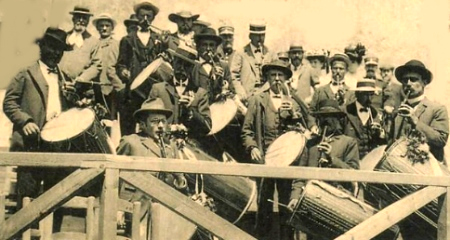
four tambourinaires playing for a dance display
21st century annual Wool Fair; playing for dance demonstrations after attending mass, Grimaud
1864 François Vidal created a Tambourine Academy in Aix-en-Provence and opened a class
at the Conservatoire of the city in 1867. Until the First World War, the tambourinaires of Provence
were semi-professional minstrels, mainly active in urban areas, who enlivened balls with transcriptions
of fashionable pieces... and also played the great tunes of lyrical or orchestral works….They often
performed during traditional Provençal festivals, in bands of tambouriniers, (sometimes several dozen),
particularly in processions for secular or religious festivals.In the last half of the 20th century and the 21st century musicians … have revived the historical musical
heritage of the tambourinaires of past centuries.1898 story:
“Having taken the musicians’ prize the day before, the famous Valmajour,
the greatest taborist of Provence…Valmajour was not an everyday taborist,
one of those common minstrels who pick up music-hall catches and odds
and ends of music at country fairs, degrading their instrument by trying to cater
to modern taste. Son and grandson of taborists, he played only the songs of his
native land…At the signal from the tabor that mob fell into line and filed off
in bands, holding each other’s hands, their legs all eager for the steps….
“But I too in my time used to get prizes myself for my tabor-playing”
… Rosalie did not like tabor-playing…Mèfre remembered that they had seen
him in the old time at the Fair of Beaucaire in a competition of tabor-players.”c.1860 Marius Sicard 1855-1927
1890-1910 group of young Mottois taborers
The galoubet continued to be popular in Provençe into the 19th and 20th centuries as the " Félibrige"
movement (founded in1854) defended and promoted local language, literature and customs, which
included the pipe and tabor.Galoubet and tambourin players were photographed in picturesque settings as part of the local
tourist marketing. Postcards were sold showing rustic individuals, groups with a conductor and larger
groups posed infront of beautiful backgrounds, religious celebrations on church steps, playing for folk
dancing with adults and children and with dancers in classical poses and settings.1890-1910 group from Pélissanne, Bouches-du-Rhône
early 20th century, procession, men and women, Toulon
1890-1910 coming out of church after midnight mass
Les Baux de Provencevase, La Couronne,
Bouches-du-Rhône1904 front cover of
'Le Petit Journal' [detail]1909 front cover of 'Le Petit Journal' [detail]
1920's postcard
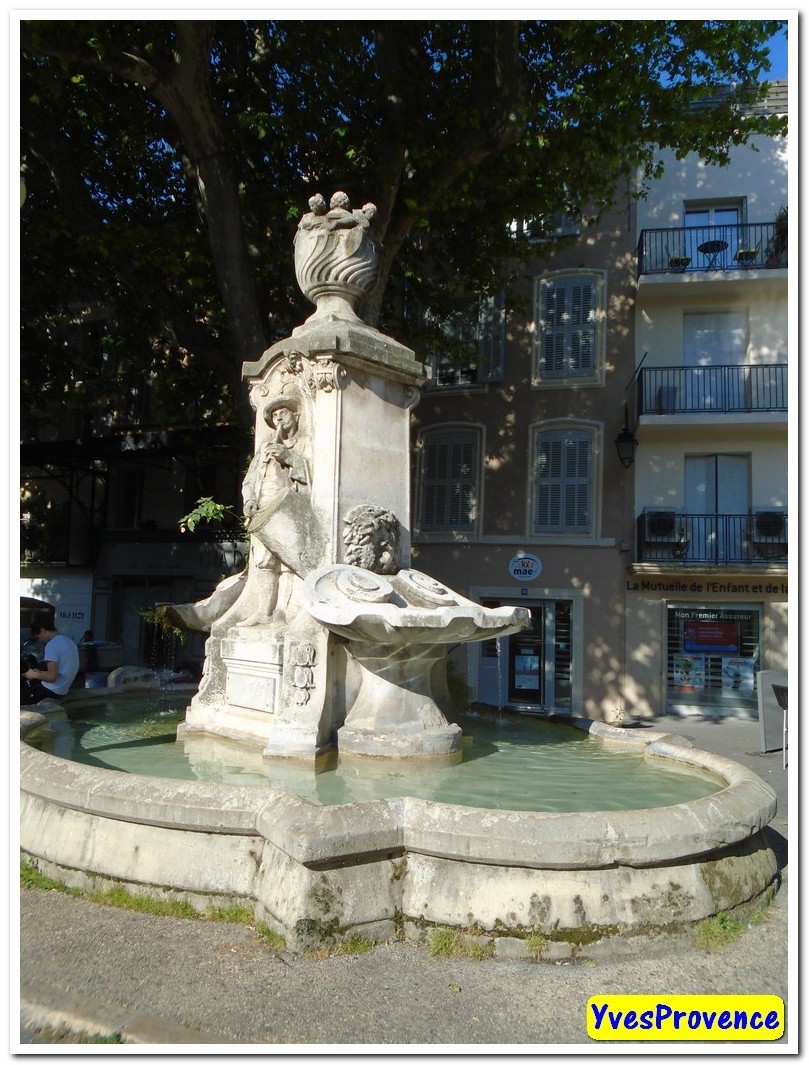
1922 Fountain Pascal
Aix-en-Provence20th century embroidered postcard
2007 Beaumes-de-Venise
2017 carnival [video]
2010
2012 folk group whose music is based on the traditional Provençal repertoire
2018 music school Christmas concert
2018 dragon festival, Mondragon, Vaucluse
2019 concert in Bédoin, Vaucluse
2019 bottle festival, St Marcellin à Boulbon
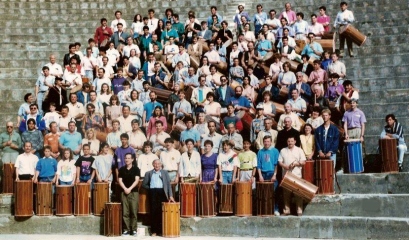
21st century Tambourin festival procession: this festival started in 1985
2022 Fête de la Crau, Fos-sur-Mer
2023 procession, La fête de la Saint Eloi, annual festival, Château Gombert
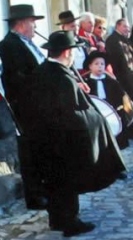
male and female players in procession
21st century procession St Tropez
singer and taborers at the Richerenches Truffle Market
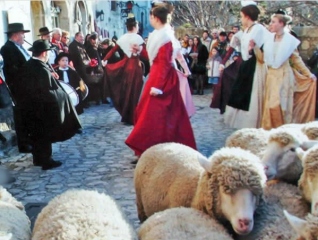
Christmas the Master Shepherd leads his flock through the village accompanied by taborers.
Women dance the farandole; Les Baux de ProvenceChristmas mass leaving church with the lamb
2024 concert given by 'Tambourinaires de Magali'
from Toulon, founded nearly 100 years agoThe Order of Tambourinaires was created in 1994 within the Mediterranean Folklore Federation.
It works on all questions of musical technique concerning the galoubet-tambourin. It mainly brings
together "masters of mallets" who have obtained the 3rd degree of tambourin.
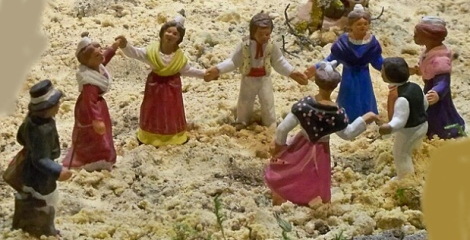
Santons became popular during the French Revolution when churches were closed and the traditional
nativity scenes in churches were prohibited. The oldest santon Fair started in Marseille in 1803. Around
one hundred workshops still carry on the tradition of making the santons de Provence.Random selection of Santon figures:
small figure
figure
figure
female
source
modern statuette
by Gérard Lamiowned by Jean-françois Garcia
list of known Provence players here list of important tambourinaires, some with photographs, here NB no women are included in this listing
Edit and additions by Frances






,_Provence_region,_France,_early_1800s,_walnut,_maple,_calfskin_-_Casadesus_Collection_of_Historic_Musical_Instruments_-_Boston_Symphony_Orchestra_-_20180113_192027.jpg)



top of page